If you want to lower your electric bill, it helps to know where the electricity actually goes. In most American homes, the answer is heating and cooling first, then water heating, and then a long list of smaller users. Your own home may be different, depending on your climate, how you heat, and which appliances you have, so this guide also shows you how to find your personal biggest users.
Table of Contents
The national picture
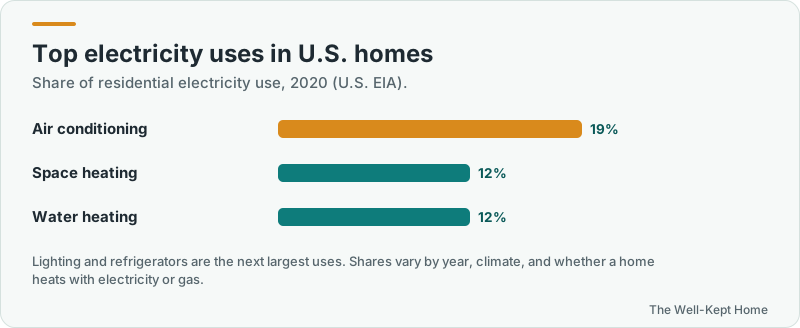
According to the U.S. Energy Information Administration’s survey of residential energy use, the three largest uses of electricity in U.S. homes in 2020 were:
- Air conditioning: about 19% of residential electricity
- Space heating: about 12%
- Water heating: about 12%
EIA lists lighting and refrigerators as the next largest uses, followed by a mix of televisions and other electronics, clothes dryers, cooking appliances, dishwashers, freezers, and computers. Shares shift from year to year with the weather, and they vary a lot by home. A house with gas heat and a gas water heater uses far less electricity for those jobs than an all-electric home.
How to estimate what an appliance costs to run
You need two numbers: how many watts the appliance draws, and how many hours it runs. Then:
- Watts × hours ÷ 1,000 = kilowatt-hours (kWh)
- kWh × your price per kWh = cost
For example, a 1,500-watt space heater running 5 hours a day uses 7.5 kWh a day. At 18 cents per kWh, close to EIA’s projected U.S. average residential price for 2026, that’s about $1.35 a day, or roughly $40 a month. Your price is on your electric bill; it may be higher or lower than the national average.
Typical power draw of common appliances
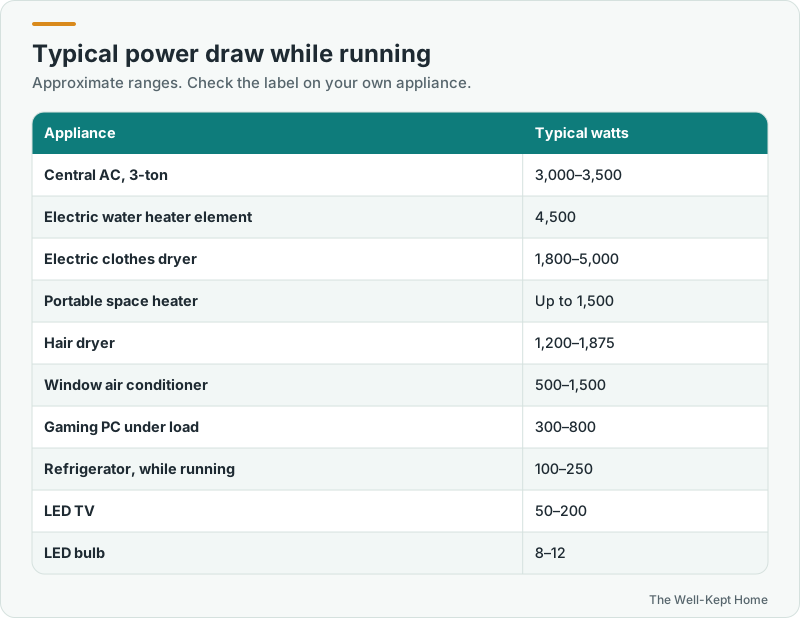
These are typical ranges. The actual wattage is usually printed on a label on the appliance or listed in its manual, and many appliances, like refrigerators and air conditioners, cycle on and off, so they don’t draw their full rating all the time.
Hidden heavy users to look for
- Electric water heaters. Their heating elements typically draw around 4,500 watts. A leak or a stuck thermostat can make them run far more than normal.
- Space heaters. At up to 1,500 watts each, a couple running all day can add a surprising amount to a winter bill.
- Old second refrigerators and freezers, especially in a hot garage.
- Dehumidifiers running nonstop in a damp basement.
- Pool pumps and hot tubs.
- Well pumps that cycle because of a leak.
- Electric vehicle charging. An EV driven 1,000 miles a month can add a few hundred kWh, depending on the vehicle.
- Gaming PCs and other high-powered electronics left running.
Finding your own biggest users
- Your utility’s online account. Many utilities with smart meters show hourly or daily usage. Look for spikes and for your overnight baseline, the usage around 3 a.m., when little should be running.
- A plug-in watt meter measures exactly what a plug-in appliance uses over time. They’re inexpensive and very useful for refrigerators, entertainment centers, and space heaters.
- Smart plugs with energy monitoring track usage of individual devices in an app.
- Whole-home energy monitors, installed in the electrical panel, show real-time usage and can help identify big loads.
An evening energy check you can do yourself
- Pull up the last 12 months of bills and note the highest and lowest months. A big summer peak points to cooling; a big winter peak points to heating or electric water heating.
- Walk through the house and list everything that runs constantly: refrigerators, freezers, dehumidifiers, aquariums, network equipment, and anything with a glowing light.
- Check the labels on your biggest appliances for wattage, or use a plug-in meter.
- Estimate the monthly cost of the top five using watts × hours ÷ 1,000 × your rate.
- Pick the two biggest costs you can change and start there.
Many utilities also offer free or low-cost professional energy audits that go further, using blower doors and infrared cameras to find air leaks. See our guide to a home energy audit.
Where to focus first
- Heating and cooling. Thermostat settings, filters, sealing leaks, and maintenance. See lowering your electric bill in summer and lowering your heating bill in winter.
- Water heating. Set the heater to 120°F, fix leaks, and use efficient showerheads.
- Old appliances. A decades-old refrigerator or freezer can use far more than a new ENERGY STAR model.
- Standby power. See how to reduce phantom power usage.
Common questions
Does a refrigerator use a lot of electricity?
It runs around the clock, which adds up, but modern ENERGY STAR refrigerators are much more efficient than older ones. Keeping coils clean and door seals tight helps; see how to clean refrigerator coils.
Do LED bulbs really make a difference?
Yes. An LED bulb uses a fraction of the power of an incandescent bulb for the same light. If you still have incandescent bulbs in frequently used fixtures, replacing them is an easy win.
Why is my bill high when I’m not using much?
Something may be running that you don’t realize, or your rate may have changed. See why your electric bill is suddenly high.