Yes, a ceiling fan can lower your air conditioning costs, but there’s a catch that many people miss. The fan itself doesn’t make the room cooler. It makes you feel cooler. The savings come only when you use that cooling effect to raise the thermostat. Run fans without changing the thermostat, and you’ve added a small electricity cost without saving anything.
Table of Contents
How ceiling fans cool you
Moving air speeds up the evaporation of moisture from your skin and carries away the warm layer of air right next to your body. It’s the same wind chill effect you feel on a breezy day. The air temperature in the room doesn’t change; in fact, a fan’s motor adds a small amount of heat. That’s why fans cool people, not rooms.
The 4-degree rule
The U.S. Department of Energy says that if you use air conditioning, a ceiling fan will let you raise the thermostat setting about 4°F with no reduction in comfort. Since your air conditioner is one of the largest electricity users in your home, letting it run at a higher setting is where the money is saved.
The math
A typical ceiling fan uses somewhere around 15 to 90 watts depending on its size, speed, and motor. Many newer models with DC motors use less. A central air conditioner uses roughly 3,000 to 3,500 watts while running. Running a 50-watt fan for eight hours uses 0.4 kWh, about 7 cents at 18 cents per kWh. If raising the thermostat 4 degrees cuts even a modest share of your AC’s runtime, the trade is heavily in your favor, as long as the fans are only running where people are.
How to get the savings
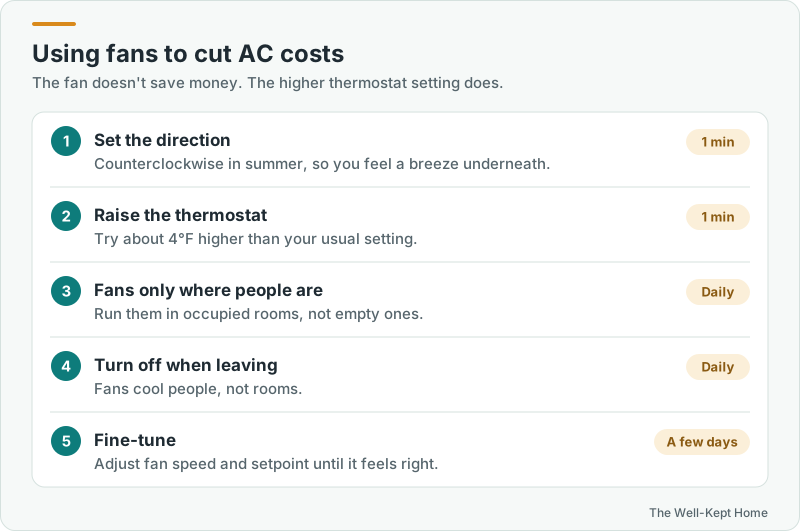
- Set the direction. In summer, the blades should spin counterclockwise when you look up at the fan, pushing air down so you feel a breeze. Most fans have a small switch on the motor housing; some use a remote or wall control.
- Raise the thermostat. Try about 4°F higher than your usual setting. If you normally keep it at 74°F, try 78°F with fans running.
- Run fans only in occupied rooms. A fan in an empty room is just using electricity.
- Turn fans off when you leave. Smart fans and timers help with this.
- Adjust. Try different speeds and settings for a few days until it feels right.
Winter use
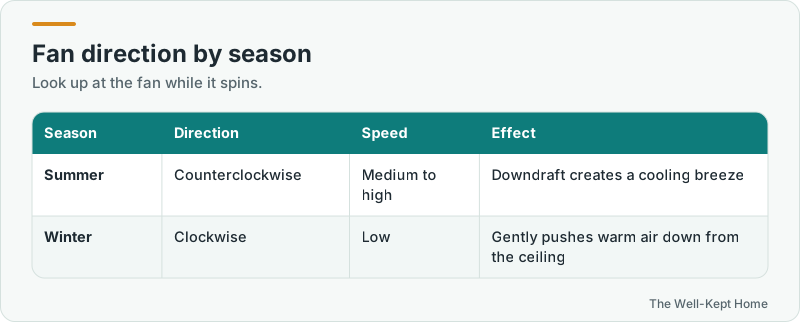
Fans help in winter too, used differently. Set the blades to spin clockwise on low speed. This gently pulls air up and pushes warm air that has collected near the ceiling down along the walls, without creating a cooling breeze. It’s most useful in rooms with high or vaulted ceilings.
Choosing an efficient fan
- ENERGY STAR certified ceiling fans are more efficient than standard models, and those with lights use efficient LEDs.
- DC motors typically use less power than traditional AC motors and often have more speed settings.
- Size matters. Larger rooms need larger blade spans to move enough air; check the manufacturer’s room-size guidance.
- Mounting height. Fans work best with the blades several feet above the floor and some distance below the ceiling. Follow the manufacturer’s clearance requirements, which also exist for safety.
When fans aren’t enough
Fans have limits. During extreme heat, moving hot air across your skin does little, and the Centers for Disease Control and Prevention warns that when temperatures are in the high 90s, electric fans may provide comfort but won’t prevent heat-related illness. Older adults, young children, people with health conditions, and pets are especially vulnerable. If your home can’t stay cool, go to an air-conditioned public place or cooling center during heat waves.
Other fans that help
- Box and pedestal fans work like ceiling fans for the people in front of them.
- Window fans at night can pull in cooler outdoor air in climates where evenings drop well below indoor temperatures.
- Whole-house fans, installed in the ceiling, can flush hot air out through the attic on cool evenings in dry climates. They’re a significant installation, so ask a contractor.
For more ways to cut cooling costs, see the best thermostat setting for summer and how to lower your electric bill in summer.
Common questions
Should I leave ceiling fans on all the time?
No. Since fans cool people rather than rooms, leaving them on in empty rooms wastes electricity. Turn them off when you leave.
Which way should my fan spin in summer?
Counterclockwise when you look up at it, at medium to high speed, so you feel the breeze.
Do ceiling fans help with humidity?
They make humid air feel more comfortable, but they don’t remove moisture. Your air conditioner or a dehumidifier does that.