Dark spots spreading across a bathroom ceiling are almost always mold or mildew feeding on the moisture from hot showers. It’s one of the most common household mold problems, and when the patch is small, you can usually clean it yourself with gentler products than bleach. But cleaning is only half the job. If the moisture that caused it isn’t fixed, the spots will be back within weeks.
Table of Contents
Why bathroom ceilings grow mold
Hot showers fill the bathroom with water vapor. It rises, condenses on the cooler ceiling, and stays there if the room doesn’t dry out quickly. Paint and the paper facing on drywall give mold something to feed on. The most common underlying causes are:
- No exhaust fan, a fan that’s too weak, or a fan that isn’t run long enough
- A fan that vents into the attic instead of outdoors
- Cold spots on the ceiling from missing attic insulation, where condensation forms
- A roof leak or plumbing leak from above
Before you start: is this a DIY job?
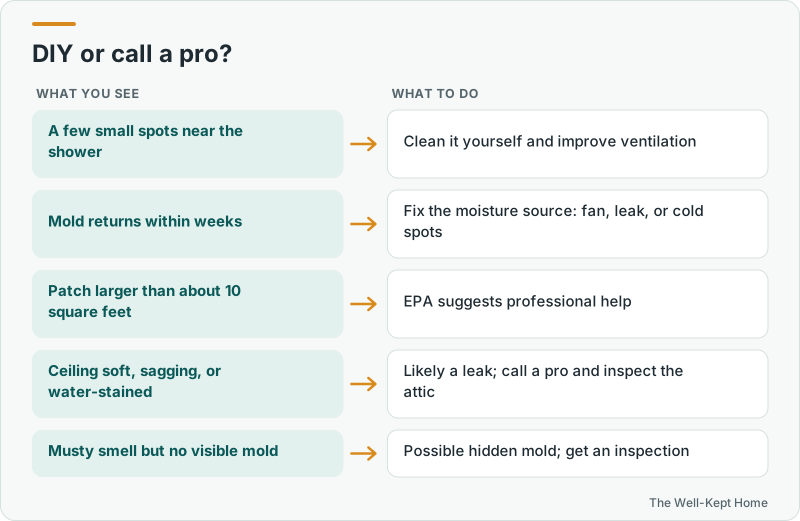
The U.S. Environmental Protection Agency suggests that if the moldy area is less than about 10 square feet, roughly a 3-by-3-foot patch, you can usually handle it yourself. Call a professional if the area is larger, if the ceiling is soft, stained, or sagging, if there’s a musty smell without visible mold, if the mold keeps returning, or if anyone in the household has asthma, allergies, or a weakened immune system. See mold remediation.
Protect yourself
Mold can irritate eyes, skin, and lungs, and you’ll be working overhead, where drips and particles fall toward your face. Wear:
- An N95 respirator or better
- Gloves
- Goggles without vents
Open a window, run the exhaust fan, and keep children and pets out of the room.
Gentler cleaning options
Detergent and water
The EPA’s basic advice for hard surfaces is to scrub mold off with detergent and water, then dry the area completely. For a lightly affected, sealed or painted surface, this is often enough.
White vinegar
Undiluted white vinegar is a popular natural option against common household molds. Spray it lightly onto the affected area, let it sit for about an hour, then wipe it with a damp cloth.
Hydrogen peroxide
Standard 3% hydrogen peroxide from the pharmacy is another option. Spray it on, let it sit for about 10 minutes, then wipe it away. It can lighten some paint colors, so test it in an inconspicuous spot first.
Never mix cleaning products. In particular, never combine vinegar with bleach, and don’t mix vinegar and hydrogen peroxide in the same bottle.
What about bleach?
Bleach is commonly used on mold, but it gives off harsh fumes in a small bathroom, it doesn’t penetrate porous materials like drywall, and the EPA doesn’t recommend using biocides like bleach as a routine part of mold cleanup. Removing the mold and fixing the moisture matters more than killing it.
Step by step: cleaning a small ceiling patch
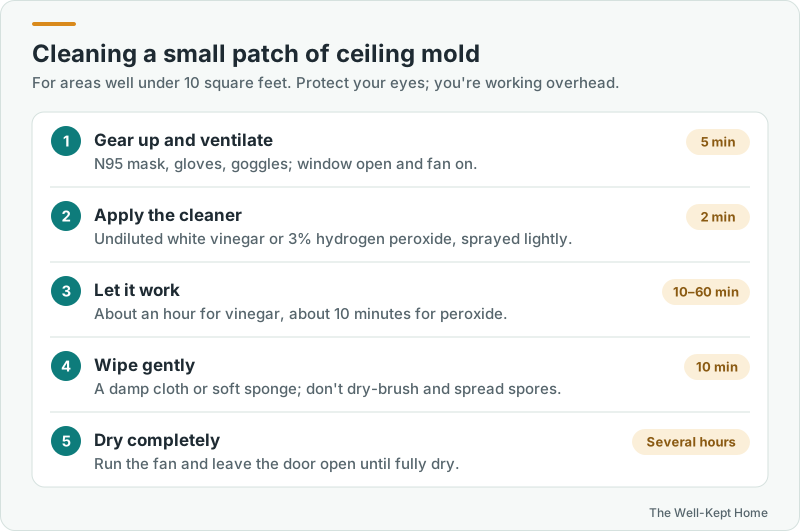
- Gear up and ventilate.
- Apply your cleaner lightly. You want the surface damp, not dripping.
- Let it work for the recommended time.
- Wipe gently with a damp cloth or soft sponge, rinsing it often. Don’t dry-brush or sand, which spreads spores.
- Dry the area completely. Run the fan and leave the door open for several hours.
- Bag and discard the cloths and sponges you used.
When stains remain
Mold can leave dark stains in paint even after it’s cleaned away. Once the area is clean and completely dry, and the moisture problem is fixed, prime it with a stain-blocking primer and repaint with a paint formulated for bathrooms, which typically includes mildew-resistant additives. Painting over active mold without cleaning it doesn’t work; it will come through.
Keep it from coming back
- Run the exhaust fan during every shower and for about 20 minutes afterward.
- Make sure the fan vents outdoors, not into the attic.
- Check the fan’s capacity. A common guideline is at least 1 cubic foot per minute of airflow for each square foot of bathroom floor, with a minimum of about 50 CFM for small bathrooms.
- Keep humidity in check. The EPA recommends indoor humidity between about 30% and 50%.
- Check the attic above the bathroom for leaks, damp insulation, or gaps that create cold spots.
- Squeegee shower walls and glass so less water evaporates into the room; see preventing water spots on shower glass.
Common questions
Is ceiling mold dangerous?
Small amounts are mostly a nuisance for healthy people, but mold can trigger allergies and asthma symptoms. Clean it promptly and fix the moisture.
Does vinegar kill mold?
Vinegar is effective against many common household molds on nonporous and painted surfaces. It won’t fix mold that has grown into drywall or the moisture problem behind it.
Why does mold keep coming back on my ceiling?
The room isn’t drying fast enough, or there’s a leak or cold spot above. Address ventilation first, then check the attic.
Should I replace the drywall?
If the drywall is soft, crumbling, or extensively moldy, it usually needs to be cut out and replaced, ideally by a professional.