Your refrigerator doesn’t make cold. It moves heat out of the food compartment and releases it into your kitchen through the condenser coils. When those coils are coated in dust, pet hair, and kitchen grease, they can’t shed heat efficiently. The compressor runs longer to keep up, which wastes electricity, adds wear, and in bad cases makes the fridge struggle to hold a safe temperature.
Cleaning the coils takes about 20 minutes and a few basic tools. Here’s how to do it safely.
Table of Contents
Find your coils first
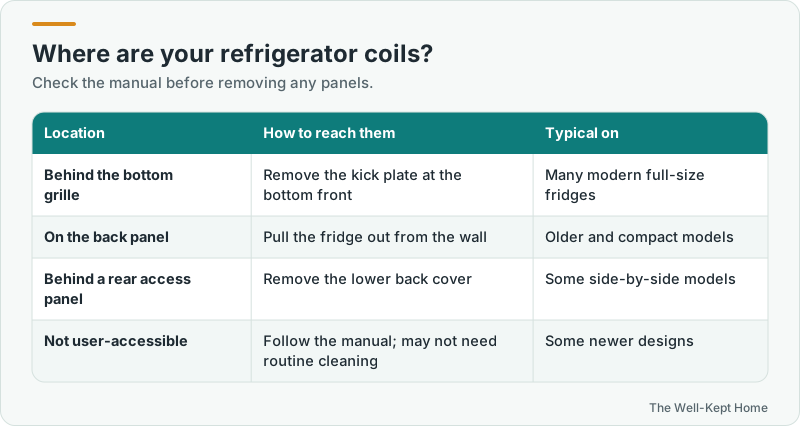
Where the coils are depends on the refrigerator:
- Behind the bottom grille. Common on many modern fridges. The coils sit underneath and are reached by removing the kick plate at the bottom front.
- On the back. Older and some compact refrigerators have a large black grid of coils on the back panel.
- Behind a rear panel. Some models hide the coils behind a removable cover at the lower back.
- Not accessible. Some newer designs don’t need routine coil cleaning, or put the condenser where homeowners aren’t meant to reach. Check the manual before taking anything apart.
What you’ll need
- A refrigerator coil brush: long, narrow, flexible, and inexpensive at hardware stores
- A vacuum with a crevice tool
- A flashlight
- A screwdriver, if your kick plate is screwed on
- Gloves, and a dust mask if dust bothers you
Step by step
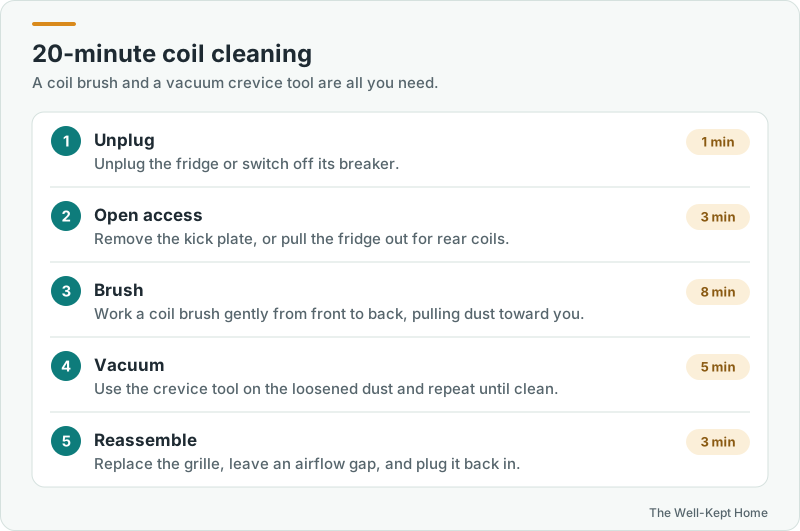
- Unplug the refrigerator or switch off its breaker. You’ll be working near the fan and electrical parts.
- Remove the kick plate at the bottom front. Most snap off; some have screws. For coils on the back, carefully pull the fridge away from the wall, taking care not to kink the water line if you have an ice maker.
- Vacuum loose dust from the grille and the area in front of the coils.
- Brush the coils. Slide the coil brush gently between and around the coils, working from front to back and pulling the dust toward you. Don’t force it. The coils and the tubing connected to them can bend.
- Vacuum again to collect what the brush loosened. Repeat until no more dust comes out.
- Clean the condenser fan if you can see it. Wipe the blades with a dry or barely damp cloth.
- Replace the kick plate and push the fridge back, leaving the gap the manual recommends for airflow, then plug it in.
Expect the fridge to run for a while after you plug it back in as it recovers from warming up. That’s normal.
How often to clean them
For most homes, every 6 to 12 months is enough. Clean them every 3 to 6 months if you have shedding pets, a dusty home, or a refrigerator in the garage. A quick look with a flashlight tells you when it’s time: a gray felt of dust on the coils means it’s due.
Does it actually save energy?
Clean coils let a refrigerator run the way it was designed to. How much you save depends on how dirty the coils were and how hard the fridge was working, so be skeptical of any specific percentage you see quoted. Clean coils matter most for older refrigerators and fridges in hot spaces such as garages, where the compressor already works hard. Either way, a fridge that runs shorter cycles puts less wear on its compressor, which is the most expensive part to replace.
Other quick checks while you’re down there
- Door seals. Close the door on a dollar bill. If it slides out with no resistance, the gasket may need cleaning or replacing.
- Temperature settings. The FDA recommends keeping the refrigerator at or below 40°F and the freezer at 0°F. A cheap appliance thermometer tells you whether the dial is telling the truth.
- Airflow inside. Don’t block the interior vents with food, and leave space around the outside of the fridge for heat to escape.
- Drain pan. Some models have a removable pan underneath. If yours does, empty and wash it, since it can be a source of odors.
Common questions
Can I use a vacuum without a coil brush?
A vacuum alone removes the loose layer on the surface, but dust packed between the coils needs a brush to break it free. Coil brushes cost a few dollars and make the job much faster.
Should I use compressed air?
Compressed air works on coils you can see, but it blows dust all over the kitchen and deeper under the fridge. If you use it, run a vacuum at the same time and wear a mask.
What if the fridge is still warm after cleaning the coils?
Give it a few hours to recover. If it still can’t hold 40°F, check that the condenser fan runs when the compressor does, that the interior vents aren’t blocked, and that the door seals properly. Persistent warming points to a failing fan, a faulty thermostat, or a sealed-system problem that needs a technician.
The refrigerator runs around the clock, which makes it one of the bigger loads in most kitchens. For more places to save, see what uses the most electricity in a home. And if you’d rather hand off the whole kitchen, see what’s included in an appliance deep cleaning service.