The thermostat is the single biggest lever you have over a summer electric bill, and the number most experts point to is 78°F. That’s the setting the U.S. Department of Energy suggests for when you’re home and need cooling. When you’re away, it recommends setting it higher. Here’s why that works, what a practical schedule looks like, and how to stay comfortable at a warmer setting.
Table of Contents
Why a higher setting saves money
Heat flows from hot to cold, and the rate depends on the temperature difference. If it’s 95°F outside and you keep the house at 72°F, heat pours in through walls, windows, and the roof, and your air conditioner has to remove all of it. At 78°F, the difference is smaller, so less heat comes in and the AC runs less.
DOE estimates you can save as much as 10% a year on heating and cooling by turning your thermostat back 7 to 10 degrees from its normal setting for eight hours a day, for example while you’re at work. Utility programs often cite savings of a few percent for each degree you raise the setting in summer, though actual savings depend on your climate, home, and system.
A sample summer schedule
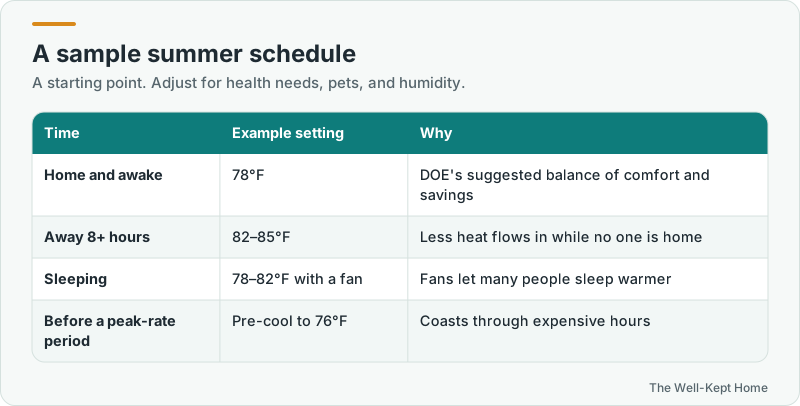
- Home and awake: 78°F, or as close as you can comfortably get.
- Away for eight hours or more: 82°F to 85°F. The house stays warm but not baking, and the AC catches up when you return.
- Sleeping: many people sleep well at 78°F to 82°F with a ceiling fan and light bedding, though comfort varies.
- Before peak-rate hours: if your utility charges more in late afternoon, pre-cool the house a couple of degrees before the peak, then let it drift up during expensive hours.
Treat these as starting points. Adjust for anyone in the household who’s elderly, very young, pregnant, or has a health condition that makes heat risky, and for pets left at home. Comfort and safety come first.
“Doesn’t the AC work harder to cool back down?”
This is the most common objection, and for most systems it’s a myth. The air conditioner does run longer when you come home, but the total energy used is still lower, because less heat leaked into the house while you were away. The exception is a very humid climate, where letting the house get too warm can let humidity build up indoors; there, a moderate setback works better than shutting the system off.
Let a smart thermostat do the work
A programmable or smart thermostat keeps the schedule without you thinking about it. Useful features include geofencing, which raises the setpoint when everyone’s phones leave the house, scheduled pre-cooling before peak hours, and humidity control on some models. See our guide to the best smart thermostat for saving energy.
How to stay comfortable at 78°F
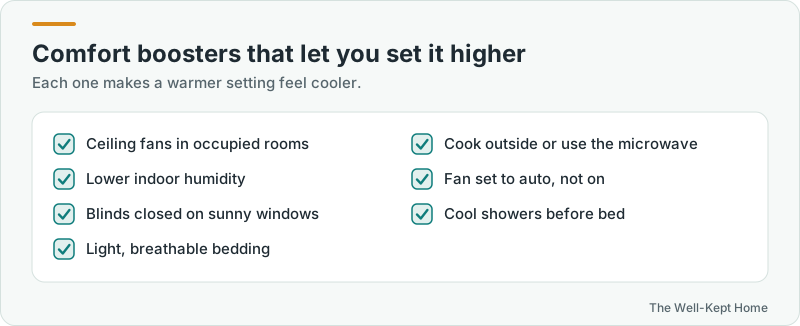
- Run ceiling fans in occupied rooms. DOE says fans let you raise the thermostat about 4°F with no reduction in comfort. Turn them off when you leave the room. See whether ceiling fans save on AC costs.
- Lower the humidity. Humid air feels warmer. In humid climates, keep the AC fan on Auto so moisture drains away, and consider a dehumidifier in damp basements.
- Block the sun on east- and west-facing windows during the hottest hours.
- Cut indoor heat by cooking outside or with the microwave, and running the dryer and dishwasher at night.
- Dress for the season and use breathable bedding.
Heat pumps and variable-speed systems
If you have a heat pump or a variable-speed air conditioner, large setbacks are less useful. These systems are most efficient running steadily at lower speeds. Smaller setbacks of 2 to 4 degrees, or simply holding a slightly warmer steady setting, often work best. Check your equipment’s guidance.
What not to do
- Don’t crank the thermostat down to cool the house faster. Most systems cool at the same rate regardless; a very low setting just overshoots and wastes energy.
- Don’t place lamps or TVs near the thermostat. Their heat makes the AC run longer.
- Don’t close lots of vents to save energy. It can unbalance the system and reduce efficiency.
The thermostat is just one part of a lower summer bill. Our full guide to lowering your electric bill in summer covers the rest.
Common questions
Is 72°F too low for summer?
It’s comfortable for many people, but it costs noticeably more to maintain than 76°F to 78°F, especially in hot climates. Try raising it one degree at a time with fans running.
Should I turn the AC off when I leave?
In moderate climates, turning it off or raising it a lot for a workday is fine. In very hot or humid areas, raise it to the low or mid 80s instead, to keep humidity in check and protect pets, plants, and electronics.
What’s a good setting at night?
Many people sleep comfortably at 78°F to 82°F with a fan. If you sleep better cooler, try lowering it only during the night and raising it during the day while you’re away.