Air conditioners rarely fail without warning. Most give small signs weeks before they quit: a little less airflow, a new noise, a few more minutes of runtime, a higher bill. Catching those early usually means a smaller repair and a technician visit on your schedule rather than an emergency call during a heat wave.
Here are the most common warning signs, what they usually mean, and what you can safely check yourself.
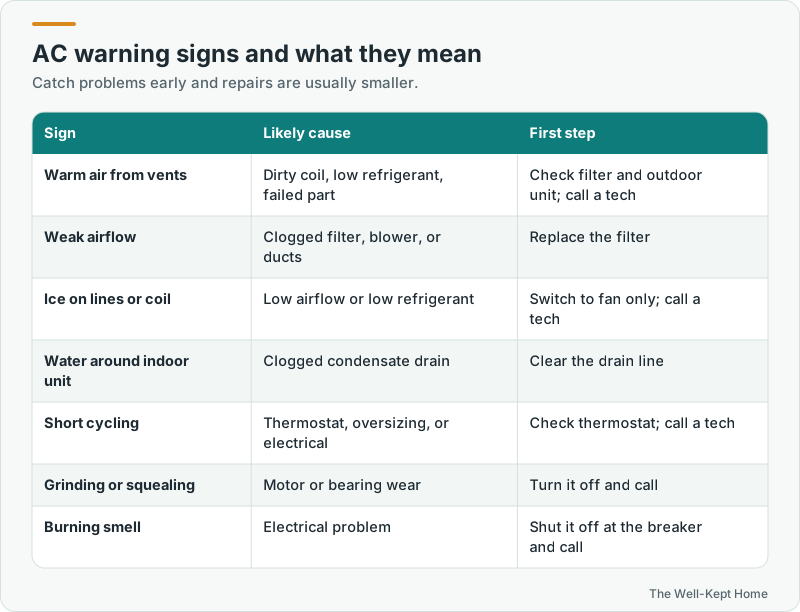
Table of Contents
1. Warm or barely cool air
If the system runs but the air coming out isn’t cold, check the thermostat first: it should be set to Cool and below the room temperature. Then check the air filter and look at the outdoor unit to see whether its fan is spinning. If all of that is fine, the cause may be a dirty coil, low refrigerant from a leak, or a failing compressor or capacitor. Those are technician jobs.
2. Weak airflow
Weak airflow from the vents usually starts with a clogged filter. Replace it and see if things improve. If not, the blower motor, a blocked or disconnected duct, or a frozen coil could be restricting airflow.
3. Ice on the refrigerant lines or indoor unit
Ice on the copper lines near the outdoor unit or on the indoor coil is a sign that something is wrong, usually low airflow or low refrigerant. Switch the thermostat from Cool to Fan Only to let the ice melt, replace the filter, and call a technician if it comes back. Running the AC while it’s iced up can damage the compressor.
4. Water around the indoor unit
Air conditioners remove moisture from the air, and that water drains away through a condensate line. If the line clogs with algae and sludge, water backs up into a drain pan and can overflow. Many homeowners can clear the line by attaching a wet/dry vacuum to its outdoor end and running it for a minute. Some systems have a float switch that shuts the AC off when the pan fills, which looks like a breakdown but is really a clog.
5. Short cycling
If the system turns on and off every few minutes without finishing a full cycle, the thermostat may be badly placed, such as in direct sun or next to a supply vent, or there may be an electrical or refrigerant problem. An oversized system can also short-cycle. It wastes energy and adds wear, so have it checked.
6. New noises
- Squealing or grinding: often motor bearings or a belt.
- Banging or clanking: a loose or broken part.
- Buzzing or humming without the fan starting: often a failed capacitor or contactor.
- Hissing: possibly a refrigerant leak.
Turn the system off if you hear grinding or banging, and call for service.
7. Bad smells
A musty smell when the AC starts can mean mold in the drain pan, the coil, or the ducts. A burning or electrical smell is more urgent: switch the system off at the thermostat and the breaker, and call a technician.
8. High humidity and rising bills
If the house feels clammy even when it’s cool, or your electric bill jumps without a change in weather or habits, the system may be losing efficiency. Dirty coils, low refrigerant, and leaky ducts are common causes.
Check these before you call
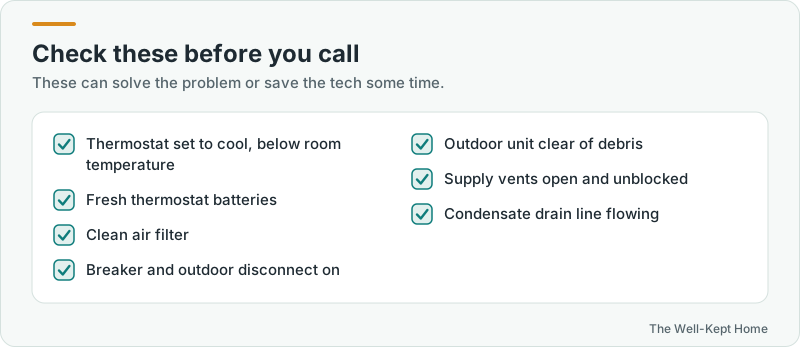
- Thermostat set to Cool and below room temperature, with fresh batteries
- A clean air filter
- The breaker on, and the outdoor disconnect switch on
- About 2 feet of clear space around the outdoor unit
- Supply vents open and not blocked by furniture
- The condensate drain line flowing
What not to do yourself
- Don’t add refrigerant. Handling refrigerant requires EPA certification, and a low charge means there’s a leak that needs repair.
- Don’t open electrical panels on the outdoor unit. Capacitors can hold a dangerous charge even with the power off.
- Don’t keep running a system that’s iced up or making grinding noises.
Prevent problems with annual service
A spring tune-up catches most of these issues before summer. A technician cleans and inspects the coils, checks the refrigerant charge, tests electrical parts, and clears the drain line. See our guide to an HVAC tune-up for what should be included, and AC maintenance costs for typical prices. Between visits, keeping the outdoor coil clean helps; see how to clean AC condenser coils.
Common questions
How old is too old for an AC?
Many central air conditioners last roughly 10 to 15 years, depending on climate and maintenance. An older system that needs a major repair is often a candidate for replacement.
Is it normal for the outdoor unit to run constantly on very hot days?
During extreme heat, long run times can be normal. If the house still can’t reach the set temperature on a moderate day, the system needs attention.
How soon should I call after noticing a problem?
Right away for ice, burning smells, or grinding noises. For milder signs, such as a small rise in bills, schedule service soon, before the hottest weeks of the year.