Few home services are marketed as aggressively as air duct cleaning. Phone calls, mailers, and coupons promise cleaner air, fewer allergies, and lower energy bills. So is it worth the money? The honest answer is: sometimes, in specific situations. For most homes without a particular problem, there are better ways to spend the same few hundred dollars.
Table of Contents
What the EPA says
The U.S. Environmental Protection Agency has published guidance on this question for years. Its key points:
- Duct cleaning has never been shown to actually prevent health problems.
- Studies don’t conclusively show that dust levels in homes rise because of dirty air ducts. Much of the dirt in ducts sticks to the duct surfaces and doesn’t necessarily enter the living space.
- Cleaning can make sense in specific circumstances: substantial visible mold growth, vermin infestation, or ducts so clogged with debris that particles blow out of the supply registers.
- If the cleaning isn’t done properly, it can actually make things worse by dislodging debris into the home.
When it’s worth it
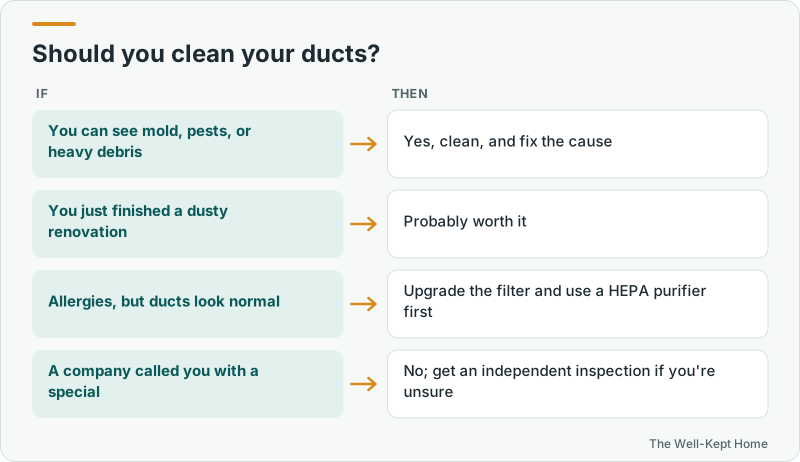
- Visible mold inside ducts, on the coil, or in the air handler. Fix the moisture problem too, or it will return.
- Pests. Rodent droppings, nests, or insect debris in the ducts.
- Heavy debris blowing out of registers.
- After a dusty renovation, especially drywall sanding or demolition with the system running.
- After smoke damage from a fire.
- Moving into a neglected home, where the system was never maintained.
When it usually isn’t
- Routine cleaning “every couple of years” in a home with no problems
- As an allergy treatment, without visible contamination
- Because of a little dust on the vent covers
- Because a company called with a limited-time special
What about energy savings?
Claims that duct cleaning cuts energy bills are mostly overstated. Dirty blower wheels and clogged coils do reduce efficiency, so cleaning those parts, typically during an HVAC tune-up, can help. The ducts themselves are a smaller factor. Leaks are a much bigger one: ENERGY STAR estimates that in a typical house, about 20% to 30% of the air moving through the duct system is lost to leaks, holes, and poorly connected ducts. Sealing ducts usually does far more for comfort and bills than cleaning them.
Better uses of the money
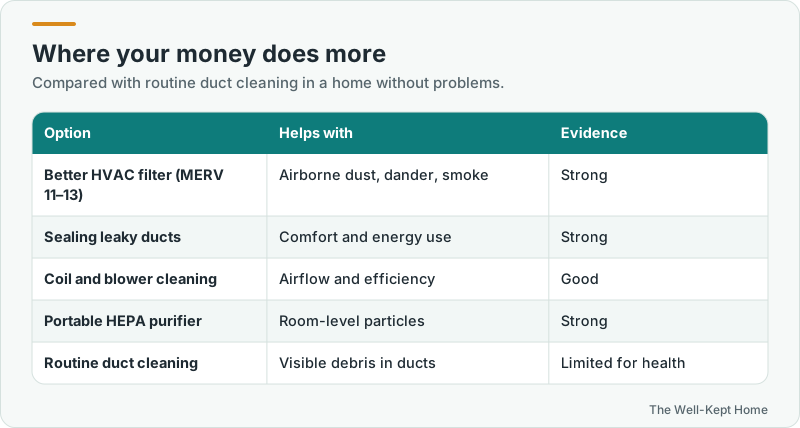
- A better filter. A pleated MERV 11 to 13 filter, changed on schedule, removes airborne particles every time the system runs. See MERV 8 vs. MERV 11.
- Duct sealing. Sealing accessible joints with mastic or foil tape, or hiring a contractor for aerosol sealing, improves comfort and efficiency.
- An HVAC tune-up that cleans the coil and blower. See what a tune-up should include.
- A portable HEPA purifier in the bedroom for allergy relief.
- Humidity control between about 30% and 50% to discourage mold and dust mites.
If you decide to have it done
A proper whole-system cleaning commonly costs roughly $450 to $1,000 for an average-sized home. Hire a company that inspects first, cleans the entire system with negative-pressure equipment, and shows you before-and-after results. Avoid “$99 whole-house” specials and anyone who promises health benefits. Our guide to hiring an air duct cleaning company covers what to ask.
Getting the most from the money you do spend
If an inspection shows your ducts genuinely need cleaning, make the visit count. Ask the company to clean the blower and, where accessible, the coil and drain pan, since those parts affect airflow and efficiency more than the duct walls do. Replace the filter right after the cleaning, and consider stepping up to a MERV 11 filter so the system stays cleaner afterward. Then fix whatever caused the problem, whether it’s a moisture leak, a gap that let pests in, or running the system during dusty work. Otherwise you’ll be paying for the same cleaning again in a few years.
A simple way to decide
Take a flashlight and look into a few supply registers and the main return after removing the grilles. Some dust is normal. Thick, clumped debris, visible mold, or signs of pests mean an inspection is worthwhile. If you see light dust, upgrade the filter and keep up with regular maintenance instead.
Common questions
Can dirty ducts make you sick?
Ducts with mold growth or pest contamination can contribute to indoor air problems, and those situations warrant cleaning. Ordinary dust in ducts hasn’t been shown to cause health problems.
How often do ducts need cleaning?
The EPA recommends cleaning only as needed. NADCA, the industry association, suggests every three to five years for many homes. An inspection is the best guide.
Does duct cleaning help with pet hair?
Pet hair is mostly caught by the filter, and much of the rest settles on floors and furniture. A good filter, regular vacuuming, and grooming do more than duct cleaning for most pet owners.
Should I clean the ducts when I buy a house?
Only if an inspection shows a problem. A home inspector or HVAC technician can look into the ducts and air handler. If the previous owners had several pets, smoked indoors, or did major renovations, cleaning is more likely to be worthwhile.