MERV 8 and MERV 11 are the two most popular filter ratings in American homes, and the difference between them is bigger than the three numbers suggest. MERV 11 captures a much larger share of the fine particles that bother allergy sufferers. MERV 8 handles everyday dust well and is easy on older systems. Which one you should buy depends on who lives in your home and what your system can handle.
Table of Contents
What MERV means
MERV stands for Minimum Efficiency Reporting Value. It comes from ASHRAE Standard 52.2, which tests how well a filter captures particles in three size ranges:
- 0.3 to 1 micron: smoke, some bacteria, and very fine dust
- 1 to 3 microns: fine dust, some pet dander, and mold spore fragments
- 3 to 10 microns: pollen, dust mite debris, lint, and larger dust
The rating, on a scale of 1 to 16 for typical filters, reflects the minimum capture efficiency in those ranges. Higher numbers capture more and smaller particles.
MERV 8 vs. MERV 11 by the numbers
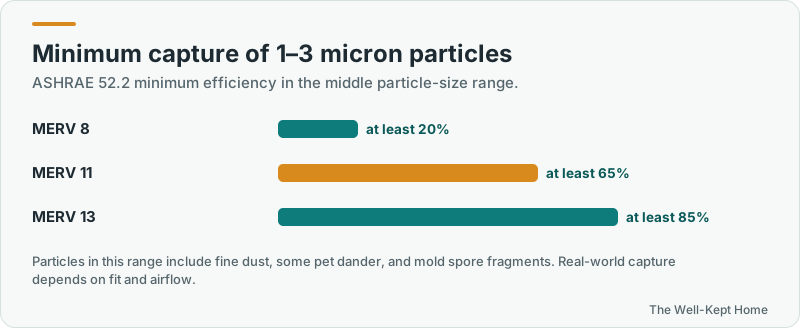
Under the standard, a MERV 8 filter must capture at least 70% of particles in the 3- to 10-micron range and at least 20% in the 1- to 3-micron range. A MERV 11 filter must capture at least 85% of the larger particles, at least 65% in the 1- to 3-micron range, and at least 20% of the smallest particles. That middle range is where much of the fine dust and some pet dander falls, and it’s where MERV 11 pulls ahead.
For comparison, a MERV 13 filter must capture at least 50% of particles in the smallest range, at least 85% in the middle range, and at least 90% of the larger particles.
What about airflow?
Higher-efficiency filters are generally denser, which can mean more resistance to airflow. In practice, the difference depends heavily on the filter’s design. Deeper pleats and thicker filters spread the load over more surface area, so a 4-inch MERV 11 often restricts airflow less than a cheap 1-inch MERV 8.
Most modern residential systems handle a 1-inch MERV 11 pleated filter without trouble, as long as it’s changed on schedule. Older systems, or systems with undersized returns, may struggle with denser filters. Signs of too much restriction include weaker airflow from the vents, a louder blower, the AC coil icing up, or the furnace cycling off on its high-limit safety switch. Check your equipment manual for the maximum recommended filter rating.
Which should you buy?
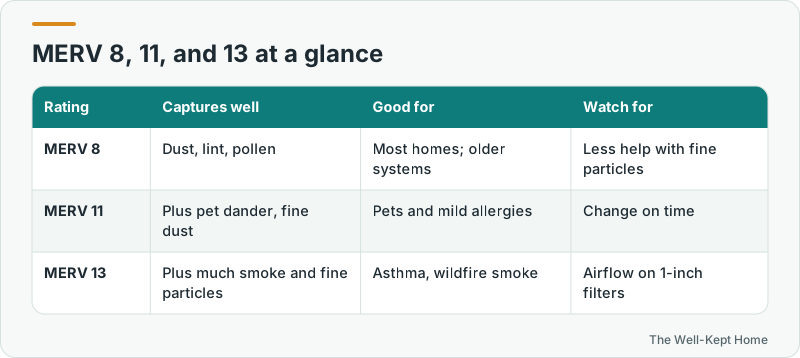
Choose MERV 8 if:
- No one in the home has allergies or asthma.
- You don’t have pets, or you have one low-shedding pet.
- Your system is older, or you’ve had airflow problems before.
- You want the lowest cost per filter.
Choose MERV 11 if:
- You have pets, especially cats or heavy shedders.
- Someone in the home has seasonal allergies.
- You notice a lot of fine dust on surfaces.
- Your system handles it without airflow problems.
Consider MERV 13 if:
- Someone has asthma or significant allergies.
- You live in an area affected by wildfire smoke. The EPA suggests using the highest-rated filter your system can accommodate, with MERV 13 as a common target.
- Your system can handle it, ideally with a thicker filter.
Brand rating systems
Some brands use their own scales instead of, or alongside, MERV. 3M’s Filtrete line uses MPR (Microparticle Performance Rating), and The Home Depot uses FPR (Filter Performance Rating). These aren’t the same as MERV, so look for the MERV equivalent on the package when comparing brands.
The cost difference
MERV 11 filters usually cost somewhat more than MERV 8 filters of the same size and brand. Because they capture more, they can also load up sooner, so budget for changing them on time. A MERV 11 filter left in too long can restrict airflow more than a fresh MERV 8. See how often to change your HVAC filter for a schedule.
Common questions
Is MERV 11 bad for my furnace?
Not for most modern systems, if it’s changed on schedule. If your manual specifies a lower maximum rating, or you notice airflow problems, step back to MERV 8 or ask a technician about a thicker media filter.
Is a higher MERV always better?
Only if your system can move enough air through it. A filter your system can’t handle well can reduce comfort and efficiency. MERV 11 to 13 is the sweet spot for most homes.
Are MERV 11 filters good for pet hair?
Yes. Pet hair is large and gets caught easily, and MERV 11 also captures more of the fine dander that causes allergy symptoms. For more on pet homes, see our guide to the best air filter for allergies and pets.