Buying an air filter should be simple, until you’re standing in the store staring at 30 sizes or measuring a filter that’s 15-1/2 inches wide when every package says 16. Here’s how to find the right size quickly, why the numbers don’t match your tape measure, and what to do if your filter has no label at all.
Table of Contents
Step 1: Check the old filter
The easiest way to find your size is to look at the filter that’s already installed. The size is almost always printed on the cardboard frame, usually along one edge, in a format like 16 x 25 x 1. Those three numbers are length, width, and depth (thickness) in inches. Write the size down or take a photo before you shop.
If you have more than one return grille, check each one. Homes with several returns often use different sizes in different places.
Why the label doesn’t match your tape measure
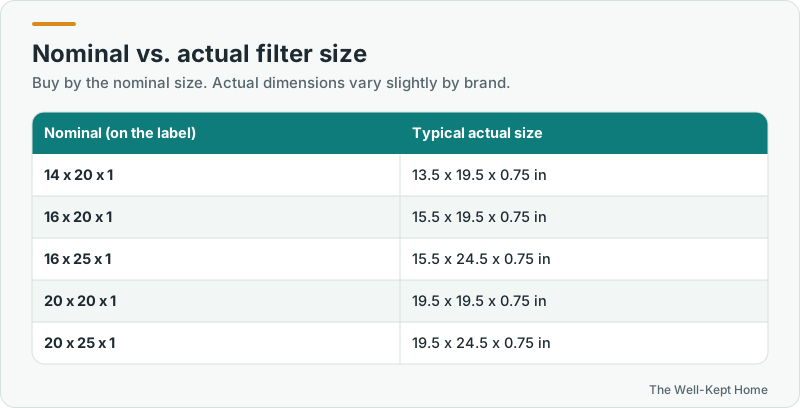
The size printed on the label is the nominal size, a rounded number used for shopping. The actual size is usually about 1/4 to 1/2 inch smaller in length and width, and a 1-inch filter is typically about 3/4 inch thick. That slight undersizing is intentional, so the filter slides into a slot or grille without forcing it.
So if you measure your filter at 15-1/2 x 24-1/2 x 3/4 inches, you need a 16 x 25 x 1 filter. Always shop by the nominal size.
Step 2: Measure if there’s no label
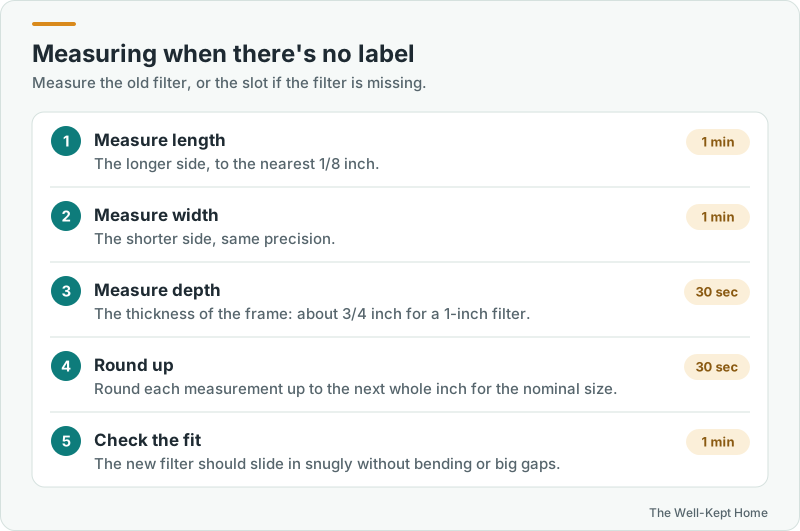
If the label is missing or unreadable, measure the old filter:
- Measure the length and width to the nearest 1/8 inch.
- Measure the depth, or thickness, of the frame.
- Round each measurement up to the next whole inch. A 19-1/2 x 24-1/2 x 3/4 inch filter becomes 20 x 25 x 1.
If there’s no filter at all, measure the opening it slides into, or the inside of the return grille’s filter frame, and choose the nominal size that fits it.
Common filter sizes
Some of the most common residential sizes are 14 x 20 x 1, 16 x 20 x 1, 16 x 25 x 1, 20 x 20 x 1, and 20 x 25 x 1. Thicker media filters often come in sizes like 16 x 25 x 4 and 20 x 25 x 4, though actual dimensions for thick filters vary more between brands, so check that they match the housing.
Choosing a thickness
- 1-inch filters fit most return grilles and furnace slots. They’re inexpensive and easy to find, but they need changing every one to three months.
- 2-inch filters fit some furnace racks and hold more dust than 1-inch filters.
- 4- to 5-inch media filters require a dedicated filter cabinet at the furnace. They last much longer, often 6 to 12 months, and typically restrict airflow less at the same efficiency rating.
You can only use the thickness your slot or cabinet is built for. If you’d like to upgrade to a thick media filter, an HVAC technician can install a media cabinet on most systems.
Mistakes to avoid
- Forcing in a filter that’s too big. A bent frame leaves gaps and can damage the housing.
- Using a filter that’s too small. Air takes the easy path around the edges, and the dust goes straight into the system.
- Stacking two filters to “double” the filtration. It restricts airflow and strains the blower.
- Cutting a filter to fit. It destroys the frame and the seal.
- Installing it backward. The arrow on the frame should point toward the furnace or air handler.
Odd sizes
If your system uses an unusual size, custom filters are widely available online, made to your exact dimensions. They cost a little more than standard sizes, so it’s worth ordering several at once.
Once you know your size, the next decision is how efficient a filter to buy. Our guide to MERV 8 vs. MERV 11 filters explains the difference, and how often to change your HVAC filter covers the schedule.
Common questions
Does the order of the numbers matter?
Not for fit. A 16 x 25 x 1 filter is the same as a 25 x 16 x 1. Depth is always the last number, and the airflow arrow tells you which way to install it.
My filter has a gap of about 1/4 inch around it. Is that normal?
A small gap is normal with nominal sizing. If air is clearly bypassing the filter, or the gap is much larger, double-check the size or use foam weatherstrip tape on the housing to close it.
Where do I write down my filter size?
Write it on the furnace or near the return grille with a marker, or save it in your phone notes. Many people also set a recurring order with the size saved.