Summer electric bills climb for one main reason: air conditioning. According to the U.S. Energy Information Administration, air conditioning accounted for about 19% of residential electricity use in 2020, more than any other single end use, and in hot regions the summer share is far higher. Electricity prices have also been rising. EIA’s outlook puts the average U.S. residential price at roughly 18 cents per kilowatt-hour in 2026, with some states paying much more.
The good news is that most of the savings come from small changes that cost little or nothing. Here’s where to start.
Table of Contents
- 1. Get the thermostat setting right
- 2. Use fans, and actually raise the thermostat
- 3. Block the sun
- 4. Don’t make heat indoors
- 5. Help your AC run efficiently
- 6. Seal leaks
- 7. Shift when you use electricity
- 8. Mind the pool and the extras
- 9. Use window and portable units wisely
- 10. Check your utility’s help programs
- Common questions
1. Get the thermostat setting right
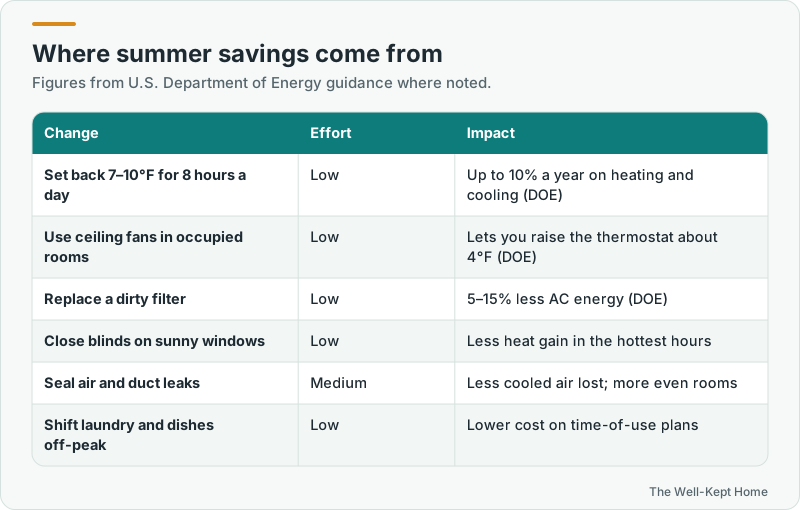
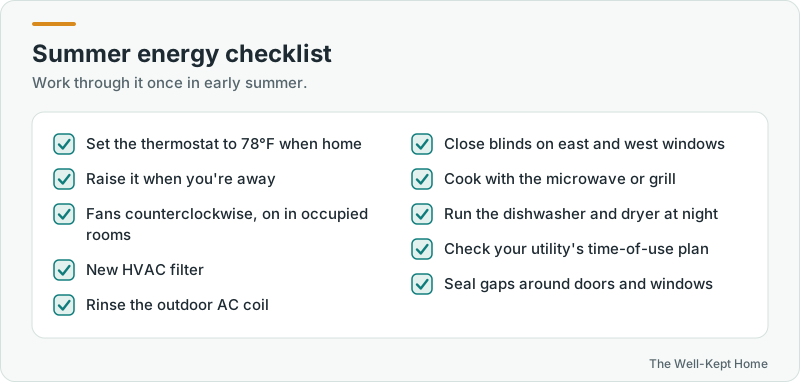
The U.S. Department of Energy suggests setting your thermostat to 78°F when you’re home and need cooling, and higher when you’re away. The less difference between indoor and outdoor temperatures, the less heat flows into your home and the less your air conditioner runs. DOE estimates you can save as much as 10% a year on heating and cooling by turning the thermostat back 7 to 10 degrees for eight hours a day.
A programmable or smart thermostat makes this automatic. Our guide to the best thermostat setting for summer walks through a sample schedule.
2. Use fans, and actually raise the thermostat
Ceiling fans don’t cool a room; they cool people by moving air across skin. DOE says a ceiling fan lets you raise the thermostat about 4°F with no reduction in comfort. The savings come from that higher setting, so turn fans off when you leave a room. In summer, fans should spin counterclockwise when you look up at them. See whether a ceiling fan saves on AC costs.
3. Block the sun
Sunlight through windows is a major source of summer heat. Close blinds and curtains on east-facing windows in the morning and west-facing windows in the afternoon. Light-colored or reflective window coverings work best. Outdoor shading, such as awnings, exterior shades, or shade trees, stops heat before it reaches the glass, which is even more effective.
4. Don’t make heat indoors
- Cook outdoors on hot days, or use the microwave, slow cooker, or air fryer instead of the oven.
- Run the dishwasher and clothes dryer in the evening, and skip the heated dry cycle on the dishwasher.
- Switch to LED bulbs, which give off far less heat than incandescent bulbs.
- Turn off electronics and gaming systems when they’re not in use.
5. Help your AC run efficiently
- Change the filter. DOE says replacing a dirty, clogged filter can lower an air conditioner’s energy use by 5% to 15%. See how often to change your HVAC filter.
- Clean the outdoor coil and keep 2 feet of space around the unit. See how to clean AC condenser coils.
- Get a spring tune-up to check the refrigerant charge and electrical parts.
- Set the fan to Auto, not On, in humid climates. Running the blower continuously can blow moisture from the wet coil back into the house.
6. Seal leaks
Gaps around doors, windows, attic hatches, and plumbing penetrations let hot, humid air in. Weatherstripping and caulk are cheap fixes. Leaky ducts matter even more: ENERGY STAR estimates that a typical home loses 20% to 30% of the air moving through its ducts to leaks and poor connections. Sealing accessible ducts in the attic or crawlspace is one of the best-value upgrades.
7. Shift when you use electricity
Many utilities offer time-of-use rates, where electricity costs more in late afternoon and early evening. If you’re on one, run the washer, dryer, and dishwasher outside peak hours, and consider pre-cooling the house slightly before the peak so the AC can coast through it. Check your utility’s website for rate options and demand-response programs that pay you for reducing use on the hottest days.
8. Mind the pool and the extras
Pool pumps can be one of the largest loads in a home. Run them only as many hours as needed for proper circulation, and consider a variable-speed pump when it’s time to replace. Unplug the old garage refrigerator if it isn’t really needed, since it works hardest in a hot garage.
9. Use window and portable units wisely
If you cool with window units, clean their filters monthly, seal the gaps around them, and cool only the rooms you’re using. Portable air conditioners, especially single-hose models, are usually less efficient than window units of similar capacity, so use them as a last resort.
10. Check your utility’s help programs
Many utilities offer free or discounted energy audits, rebates on efficient equipment, and budget billing that spreads costs evenly through the year. Households struggling with bills may qualify for assistance through the federal Low Income Home Energy Assistance Program (LIHEAP), administered by each state.
Common questions
Is it cheaper to leave the AC on all day?
Usually not. Raising the setpoint while you’re away reduces the heat flowing into your home, so the system uses less energy overall, even accounting for the cool-down when you return. In very humid climates, raise it moderately rather than switching it off, so humidity stays under control.
What’s the biggest single change I can make?
For most homes, it’s the thermostat: a higher setting when you’re home, combined with fans, and a larger setback when you’re away.
Do blackout curtains really help?
Yes, especially on sun-facing windows during the hottest part of the day. They reduce the heat that enters through the glass.