Air conditioner maintenance isn’t expensive, especially compared with the cost of a breakdown in July. National cost guides commonly put a single AC tune-up at roughly $65 to $200, and annual service plans at about $150 to $500 a year. Here’s what you get for that money, what can add to the bill, and which tasks you can handle yourself to keep costs down.
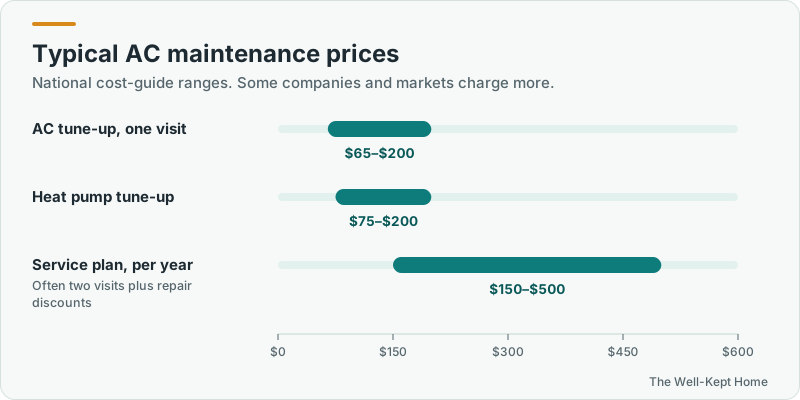
Table of Contents
What a tune-up costs, and what it covers
A standard AC tune-up, sometimes called a maintenance visit or a precision tune-up, typically includes cleaning and inspecting the outdoor coil, checking the refrigerant charge, testing the capacitor and contactor, tightening electrical connections, clearing the condensate drain, checking airflow and the thermostat, and replacing or checking the filter. Our guide to an HVAC tune-up lists everything a good visit should include.
Prices vary by region, by company, and by how much cleaning the system needs. Some companies and some markets come in above the typical range, and heat pump tune-ups cost about the same, though heat pumps benefit from a visit in both spring and fall.
Service plans: are they worth it?
Maintenance plans, also called service agreements or memberships, usually include two visits a year, one for cooling and one for heating, plus perks such as:
- Priority scheduling during busy seasons
- Discounts on repairs, often around 10% to 15%
- Waived or reduced trip fees
- Reminders, so maintenance doesn’t get forgotten
A plan makes sense if you’d otherwise skip maintenance, if you have both a furnace and an AC, or a heat pump that needs two visits a year, and if the plan price is close to what two individual visits would cost. It makes less sense if the plan is mainly a vehicle for upsells, or if you’d use the same company for repairs without the discount.
Extra charges you might see
A tune-up often uncovers small problems. Common add-ons include:
- Capacitor replacement. A frequent failure point, especially in hot climates.
- Clearing a badly clogged condensate drain.
- Deep chemical coil cleaning beyond a standard rinse.
- Refrigerant. If the system is low, there’s a leak, and the real fix is finding and repairing it, not just refilling.
Ask for prices before the technician starts any repair, and get a second opinion on anything major.
A note on refrigerants
The type of refrigerant in your system affects repair costs. Systems that use R-22, the old standard, rely on a limited supply of recovered refrigerant, because new production and import ended in 2020, which makes recharges very expensive. Since 2025, new residential systems in the U.S. have been shifting to lower-impact refrigerants such as R-454B and R-32. Existing R-410A systems can still be serviced. If your system is old and uses R-22, a large refrigerant repair is often a signal to think about replacement.
What you can do yourself
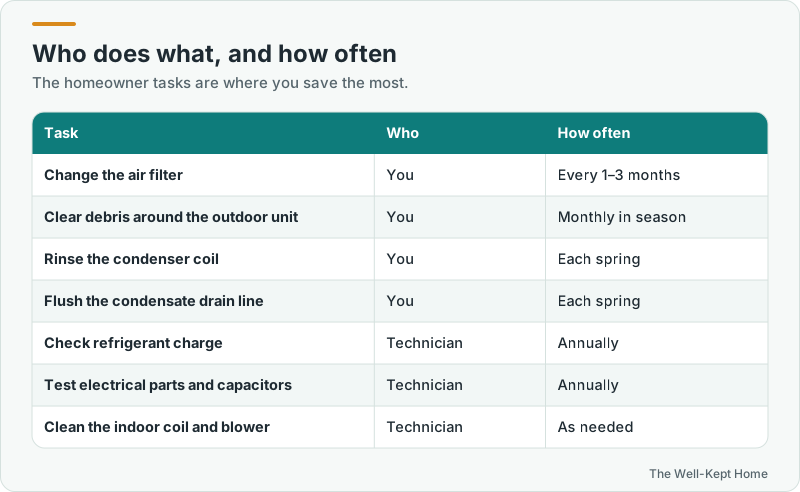
Several maintenance tasks need no special tools, and doing them saves money and helps your technician’s visit go further:
- Change the air filter every one to three months. See how often to change your HVAC filter.
- Keep the outdoor unit clear, with about 2 feet of space around it.
- Rinse the condenser coil in spring. See how to clean AC condenser coils.
- Flush the condensate drain line with a wet/dry vacuum or a cup of vinegar, if your manufacturer allows it.
- Use a programmable or smart thermostat to reduce runtime when you’re away.
Leave refrigerant, electrical testing, and anything inside sealed panels to a licensed technician.
How to keep costs down
- Book tune-ups in early spring and early fall, when companies are less busy and sometimes offer seasonal pricing.
- Compare plan prices against two individual visits.
- Keep records of maintenance; they can help with warranty claims.
- Fix small problems early. A worn capacitor is a modest repair, while a compressor damaged by running on a failing capacitor is a major one.
- Watch for warning signs your AC needs servicing so problems don’t grow.
Common questions
How often does an AC need professional maintenance?
Once a year for most central air conditioners, ideally in spring. Heat pumps benefit from a visit in spring and fall.
Is a $49 tune-up a good deal?
Sometimes, but very low prices are occasionally used to get in the door for upselling. Ask for the checklist and be cautious about urgent recommendations made on the spot.
Does maintenance really extend the life of an AC?
Regular maintenance keeps parts clean, catches small failures early, and reduces strain on the compressor, all of which help a system reach its expected lifespan instead of failing early.