If you looked into home energy incentives a year or two ago, the landscape has changed. The two biggest federal tax credits for homeowners, the 25C credit for efficiency improvements and the 25D credit for solar and other clean energy, ended after 2025 under the budget law signed on July 4, 2025. That doesn’t mean help has disappeared. State rebate programs, utility incentives, and assistance programs still cover a meaningful share of many upgrades. Here’s what changed and where to look in 2026.
Table of Contents
What ended
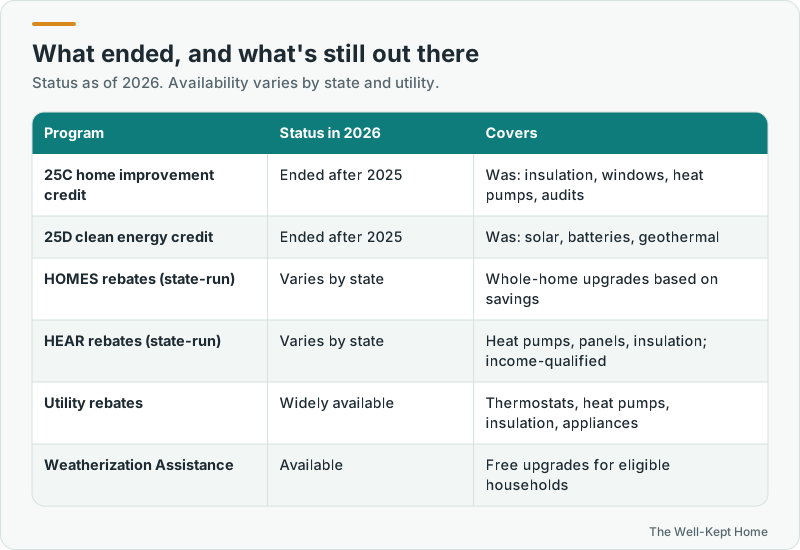
The Energy Efficient Home Improvement Credit (25C)
This credit covered 30% of the cost of qualifying insulation, air sealing, windows, doors, heat pumps, efficient furnaces and water heaters, electrical panel upgrades, and home energy audits, up to annual limits. According to the IRS, it doesn’t apply to property placed in service after December 31, 2025.
The Residential Clean Energy Credit (25D)
This credit covered 30% of the cost of solar panels, battery storage, geothermal heat pumps, and similar systems. It ended for expenditures made after December 31, 2025. See solar panel installation cost for what that means for solar buyers.
If you completed qualifying projects in 2025, you may still be able to claim these credits on your 2025 tax return. A tax professional can confirm.
What’s still available
State Home Energy Rebates (HOMES and HEAR)
The 2022 Inflation Reduction Act funded two rebate programs that states run themselves:
- HOMES (Home Efficiency Rebates) pays for whole-home upgrades based on modeled or measured energy savings.
- HEAR (Home Electrification and Appliance Rebates) helps income-qualified households pay for heat pumps, heat pump water heaters, electrical panels and wiring, insulation, and air sealing. Program summaries commonly cite a combined cap of up to $14,000 per household, depending on the upgrade and the state’s design.
These programs are rolling out unevenly. Some states launched them and have been taking applications; others haven’t launched, and in some states popular categories have already been fully reserved. Your state energy office’s website is the best place to check current status, eligibility, and participating contractors.
Utility rebates
Electric and gas utilities offer some of the most reliable incentives, commonly for:
- Smart thermostats; see the best smart thermostat for saving energy
- Heat pumps and heat pump water heaters
- Attic insulation and air sealing
- ENERGY STAR appliances
- Recycling old refrigerators and freezers
- Home energy audits, often free or discounted
Many utilities also offer on-bill financing or low-interest loans for efficiency upgrades.
Weatherization Assistance Program
The U.S. Department of Energy’s Weatherization Assistance Program provides free efficiency upgrades, such as insulation, air sealing, and heating system repairs, to income-eligible households, through state and local agencies. Bill payment help is available separately through the Low Income Home Energy Assistance Program (LIHEAP).
State and local tax incentives
Some states offer their own tax credits for efficiency or renewable energy, and many exempt solar equipment from property or sales tax.
Manufacturer and retailer rebates
Equipment makers and retailers sometimes offer seasonal rebates on efficient appliances and HVAC equipment.
How to find rebates for your project
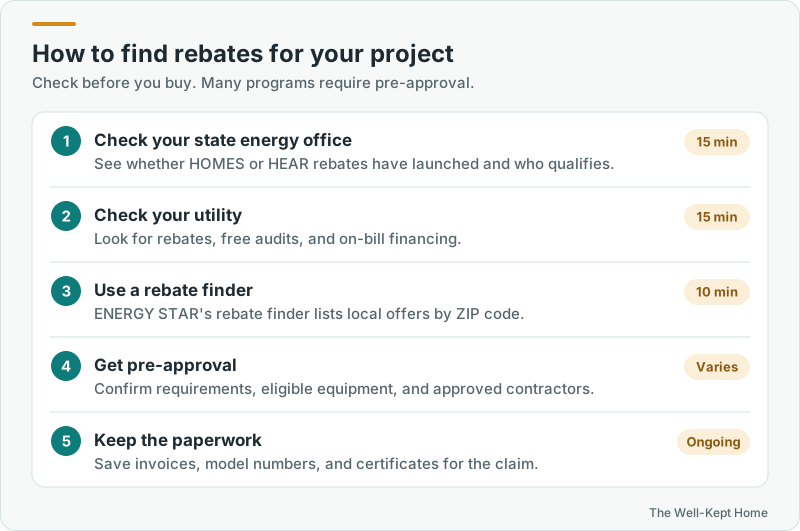
- Check your state energy office for HOMES and HEAR status and any state programs.
- Check your utility’s website for rebates, audits, and financing.
- Use ENERGY STAR’s rebate finder, which lists local offers by ZIP code.
- Get pre-approval before buying. Many programs require it, along with specific equipment ratings or an approved contractor.
- Keep everything: invoices, model numbers, efficiency certificates, and photos.
Getting the most from limited incentives
- Start with an energy audit. It’s often subsidized and helps you prioritize. See home energy audits.
- Prioritize cheap, effective upgrades such as air sealing and attic insulation, which are often well rebated; see attic insulation cost.
- Plan replacements before equipment fails. Emergency replacements leave no time to apply for rebates.
- Read the stacking rules. Some programs can’t be combined for the same upgrade.
Common mistakes that cost people rebates
- Buying first, applying later. Many programs reject projects that started before approval.
- Using a contractor who isn’t approved when the program requires a participating one.
- Choosing equipment that misses the required rating, such as a specific efficiency tier or certification.
- Missing paperwork, like model numbers, efficiency certificates, or itemized invoices.
- Assuming last year’s rules still apply. Incentives changed significantly between 2025 and 2026, so always check current terms.
Common questions
Is there any federal tax credit for home energy upgrades in 2026?
The main homeowner credits, 25C and 25D, ended after 2025. Federal funds still flow through state-run rebate programs and the Weatherization Assistance Program.
Do I have to be low-income to get rebates?
No. HEAR is income-qualified, but HOMES and most utility rebates are open to all eligible customers, sometimes with higher amounts for lower-income households.
When should I apply?
Before you buy. Many programs won’t pay for work that started before approval, and funding can run out.