Heat pumps have become the default recommendation for efficient heating, and for good reason: they move heat instead of making it, so they can deliver two to four units of heat for every unit of electricity they use. But whether a heat pump actually costs less to run than a gas furnace depends on three things that vary from home to home: your electricity price, your natural gas price, and how cold your winters get. Here’s how to compare them for your own situation.
Table of Contents
The efficiency numbers that matter
- Furnaces are rated by AFUE (Annual Fuel Utilization Efficiency). A 95% AFUE furnace turns 95% of the fuel’s energy into heat for your home. Older furnaces are often around 80%.
- Heat pumps are rated by COP (Coefficient of Performance) at a given temperature, and seasonally by HSPF2. A COP of 3 means 3 units of heat for every unit of electricity. COP drops as outdoor temperatures fall, so a heat pump is most efficient in mild weather.
A worked example
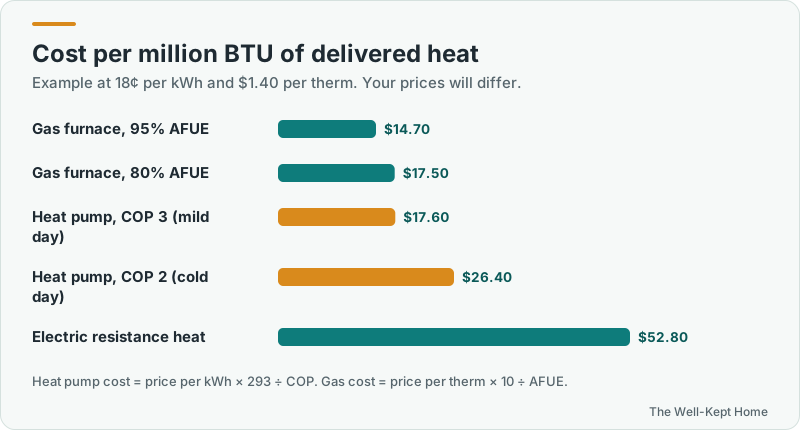
To compare fuels fairly, convert everything to the cost of one million BTU of heat delivered into your home. This example uses roughly national-average prices: electricity at 18 cents per kWh, close to EIA’s projected 2026 U.S. average, and natural gas at $1.40 per therm, about $14 per million BTU, near the recent national average residential price.
- High-efficiency gas furnace (95% AFUE): about $14.70 per million BTU of heat
- Older gas furnace (80% AFUE): about $17.50
- Heat pump on a mild day (COP 3): about $17.60
- Heat pump on a cold day (COP 2): about $26.40
- Electric resistance heat (baseboard or electric furnace): about $52.80
At these national-average prices, a modern heat pump costs roughly the same to run as an older gas furnace in mild weather, and a high-efficiency gas furnace is cheaper on cold days. Heat pumps beat electric resistance heat by a wide margin in every case.
Run the numbers yourself
Your electricity and gas prices may be very different from the national averages. Electricity alone ranges from about 12 cents per kWh in some states to more than 40 cents in Hawaii. Use these formulas with the prices from your own bills, including delivery charges:
- Heat pump: price per kWh × 293 ÷ COP = cost per million BTU
- Gas furnace: price per therm × 10 ÷ AFUE (as a decimal) = cost per million BTU
For example, at 13 cents per kWh and a COP of 3, a heat pump costs about $12.70 per million BTU, cheaper than a 95% furnace at $1.40 per therm. At 30 cents per kWh, the heat pump costs about $29.30, more than the furnace.
When each option tends to win
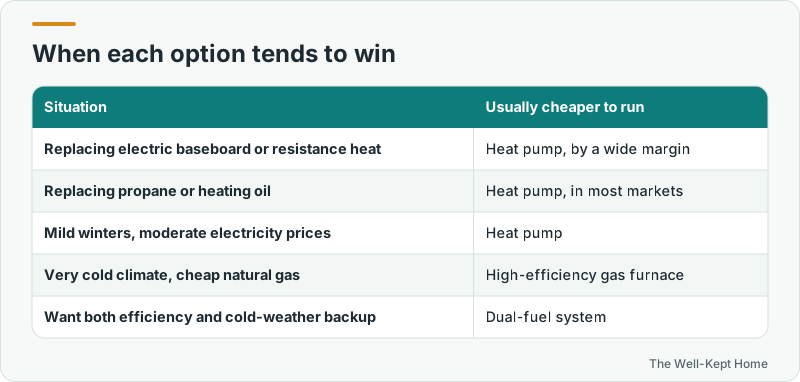
- Replacing electric resistance heat: a heat pump is far cheaper to run.
- Replacing propane or heating oil: these fuels usually cost more per unit of heat than natural gas, so heat pumps often win.
- Mild climates: heat pumps run at high efficiency most of the winter.
- Very cold climates with cheap gas: a high-efficiency furnace may cost less to run, though cold-climate heat pumps have narrowed the gap.
- Dual-fuel systems pair a heat pump with a gas furnace and switch to gas when it’s too cold for the heat pump to run economically. They offer the best of both.
Other costs to consider
- Cooling. A heat pump is also your air conditioner. If you need a new AC anyway, the extra cost of a heat pump over an AC is often modest.
- Fixed gas charges. If a heat pump lets you disconnect gas entirely, you save the monthly customer charge, which can be significant.
- Backup heat. Many heat pumps use electric resistance strips on the coldest days. A properly sized cold-climate unit and good thermostat settings minimize this; see how to lower your heating bill in winter.
- Your home’s efficiency. Air sealing and insulation shrink the heating load and make a smaller, cheaper heat pump possible; see attic insulation.
- Incentives. The federal heat pump tax credit ended after 2025, but some states and utilities offer rebates; see energy efficiency rebates.
Common questions
Do heat pumps work in cold climates?
Modern cold-climate heat pumps can keep heating well below freezing, with reduced efficiency as temperatures drop. Many homes in cold regions use them with backup heat or as part of a dual-fuel system.
Is a heat pump cheaper than gas?
Sometimes. It depends on your local prices, your climate, and the efficiency of both systems. Use the formulas above with your own bills.
How long do heat pumps last?
Many heat pumps last roughly 10 to 15 years or more with maintenance, similar to central air conditioners. Annual service helps; see HVAC tune-ups.