When most people think of air leaks, they picture a drafty window. But the leaks that cost the most are usually somewhere you never look: in the attic and in the basement or crawlspace. Finding and sealing them is one of the cheapest ways to make a home more comfortable and lower heating and cooling bills. ENERGY STAR estimates that homeowners can save an average of 15% on heating and cooling costs by sealing air leaks and adding insulation in attics, floors over crawlspaces, and accessible basement rim joists.
Table of Contents
Why the attic and basement matter most
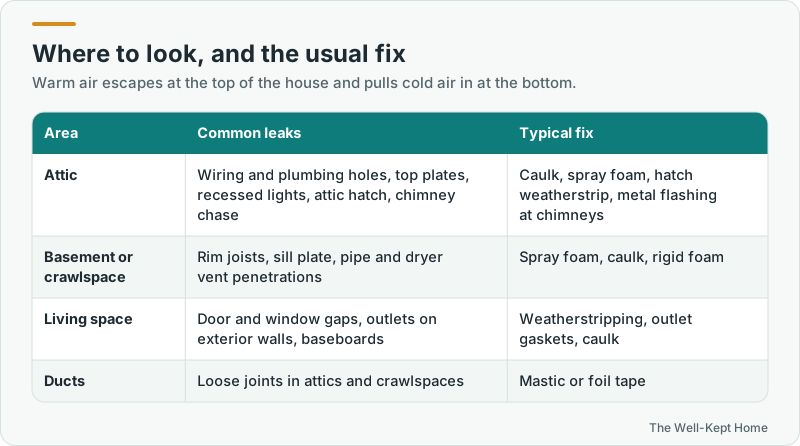
Warm air rises. In winter, heated air pushes up and escapes through gaps in the ceiling into the attic. As it leaves, it pulls cold outdoor air in through gaps lower in the house: the basement, the crawlspace, and the rim joists. Building scientists call this the stack effect. That’s why the biggest, most valuable leaks are usually at the top and bottom of the house, not in the middle.
Where to look
In the attic
- Holes where wiring, plumbing vents, and ducts pass through the ceiling
- The top plates of interior walls, where wall cavities open into the attic
- Recessed light fixtures that aren’t airtight
- The attic hatch or pull-down stairs
- Chimney and flue chases
- Dropped ceilings and soffits over kitchen cabinets
- Bath fan housings
In the basement or crawlspace
- The rim joist, the band of wood sitting on top of the foundation wall
- The sill plate, where the wood framing meets the concrete
- Penetrations for plumbing, gas lines, wiring, and the dryer vent
In the living space
- Gaps around exterior doors and windows
- Electrical outlets and switches on exterior walls
- Baseboards and gaps where floors meet walls
- The fireplace damper
- Pet doors, mail slots, and window AC units
Simple ways to find leaks
The hand test
On a cold, windy day, run the back of your hand slowly around doors, windows, outlets, and baseboards. You’ll feel drafts at the worst spots.
Look for clues
In the attic, look for dark, dirty patches in the insulation. Air carrying dust has been filtering through it, which is a sign of a leak below. Cobwebs that move, light coming through gaps, and frost on the underside of the roof in winter are other clues. In the basement, look for daylight around the rim joist.
The dollar bill test
Close a door or window on a dollar bill. If it slides out easily, the weatherstripping isn’t sealing.
The smoke test
Depressurizing the house makes leaks easier to find, because outside air is pulled in through every gap.
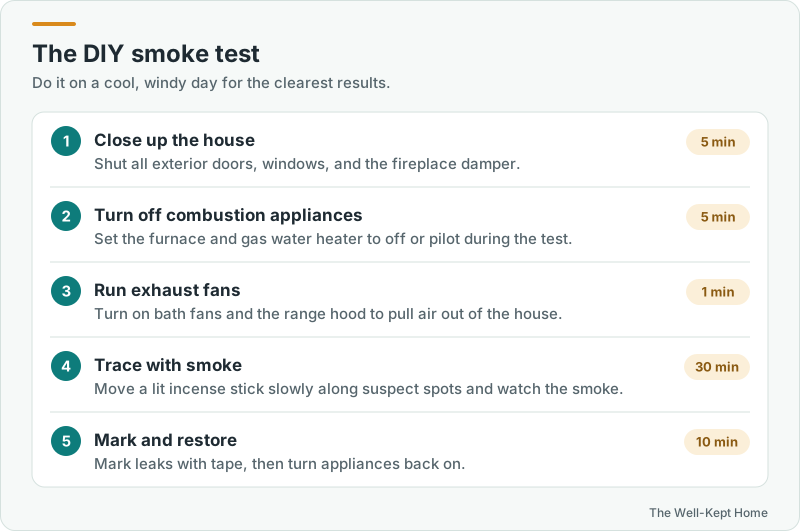
Do this carefully. Running exhaust fans with the house closed up can cause gas appliances, such as a furnace or water heater, to backdraft exhaust into the home. Set them to off or pilot during the test, and turn them back on afterward. Never do the test near an open flame or a fireplace that’s in use.
A thermal camera
Infrared cameras, including inexpensive phone attachments, show cold spots on walls and ceilings in winter. They work best when there’s a large temperature difference between inside and outside. A professional energy audit combines a thermal camera with a blower door test for the most complete picture; see home energy audits.
How to fix what you find
- Small gaps (under 1/4 inch): caulk.
- Larger gaps and holes around pipes and wires: expanding spray foam.
- Doors and windows: weatherstripping and door sweeps; see how to weatherstrip doors and windows.
- Outlets and switches: foam gaskets behind the cover plates.
- Attic hatch: weatherstripping plus a rigid foam board glued to the top.
- Around chimneys and flues: sheet metal and high-temperature fire-rated sealant, never spray foam, because of fire risk.
- Ducts: mastic or foil tape at joints, not cloth duct tape.
A note on ventilation and safety
A tighter house is more efficient, but every home needs fresh air. Make sure bathroom and kitchen exhaust fans vent outdoors and work properly. If you seal a lot of leaks, especially in a home with gas appliances, have the combustion appliances checked for safe venting, and keep carbon monoxide alarms working on every level.
Common questions
What’s the single most important leak to fix?
In many homes, it’s the collection of holes in the attic floor, followed closely by the attic hatch and the basement rim joist.
Do I need a professional?
Not for the basics. Attic air sealing can be dusty, cramped work, and a contractor can do it efficiently when adding insulation; see attic insulation installation.
Can a house be too tight?
Very tight homes need mechanical ventilation to maintain air quality. Most existing homes are nowhere near that point, but an energy auditor can tell you.