Home solar costs have changed in an important way. For years, homeowners who bought a system could claim a 30% federal tax credit. That credit, known as Section 25D, ended for expenditures made after December 31, 2025, under the budget law signed on July 4, 2025. For homeowners buying a system in 2026, the price before incentives is now much closer to the price they actually pay.
Here’s what residential solar typically costs in 2026, what drives the price, and how to judge whether it makes sense for your home.
Table of Contents
What solar costs in 2026
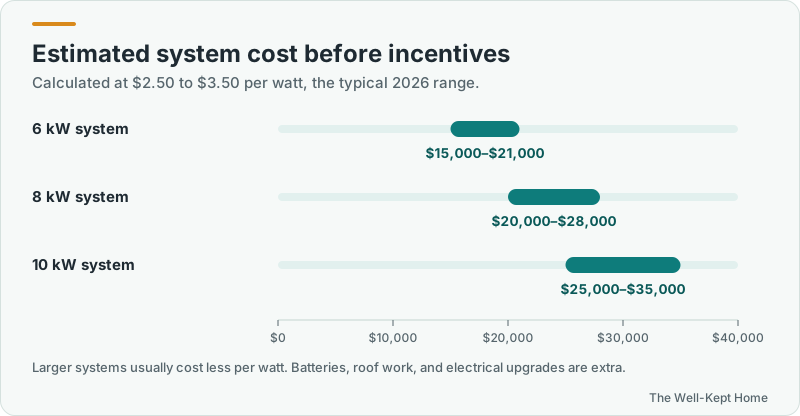
Solar is usually priced per watt of system capacity. Across 2026 sources, typical residential prices fall roughly between $2.50 and $3.50 per watt before incentives. Quotes gathered through online solar marketplaces cluster toward the lower end, around $2.60 per watt in early 2026, while broader installed-price data from Lawrence Berkeley National Laboratory shows a median closer to $3.50 per watt for cash purchases. Some installers have reported prices rising slightly after the law changed, as demand spiked ahead of the deadline.
For a common 8-kilowatt system, that works out to roughly $20,000 to $28,000 before any state or utility incentives. Larger systems generally cost less per watt, and prices vary by state; competitive markets tend to be cheaper.
What goes into the price
- Panels, the most visible part but often less than half the total cost
- Inverters: a central string inverter, or microinverters or optimizers at each panel
- Racking and mounting hardware
- Labor and electrical work, sometimes including an electrical panel upgrade
- Permits, inspections, and utility interconnection
- Company overhead and sales costs, which vary widely
- Batteries, if you add storage, which adds substantially to the total
How big a system do you need?
Start with your annual electricity use, which is on your utility bills. A system’s output depends on its size, your location, roof direction and pitch, and shading. NREL’s free PVWatts calculator estimates production for your address. A good installer will model production for your specific roof, not just give a rule of thumb.
What’s left for incentives
- State incentives. Some states offer rebates, tax credits, or performance payments.
- Property and sales tax exemptions for solar equipment in many states.
- Utility programs, including export credits for power you send to the grid. These rules vary a lot. Some states moved from full retail-rate net metering to lower export rates, which makes self-consumption and batteries more important.
- Leases and power purchase agreements. These are structured differently from purchases, and some installers say third-party-owned systems can still benefit from business tax credits for a limited time. Ask any installer to spell out exactly which incentives their price assumes.
For other upgrades and programs, see energy efficiency rebates for homeowners.
Is solar still worth it without the federal credit?
It depends on four things: your electricity price, how much sun your roof gets, how your utility credits exported power, and how long you’ll stay in the home. Electricity prices have been rising; EIA projects the average U.S. residential price at roughly 18 cents per kWh in 2026, and in high-price states the case for solar remains strong. In states with cheap electricity and low export credits, payback periods have grown longer without the 30% credit.
Before going solar, it often makes sense to cut usage first. Efficiency upgrades let you buy a smaller system; see what uses the most electricity in a home.
How to compare quotes
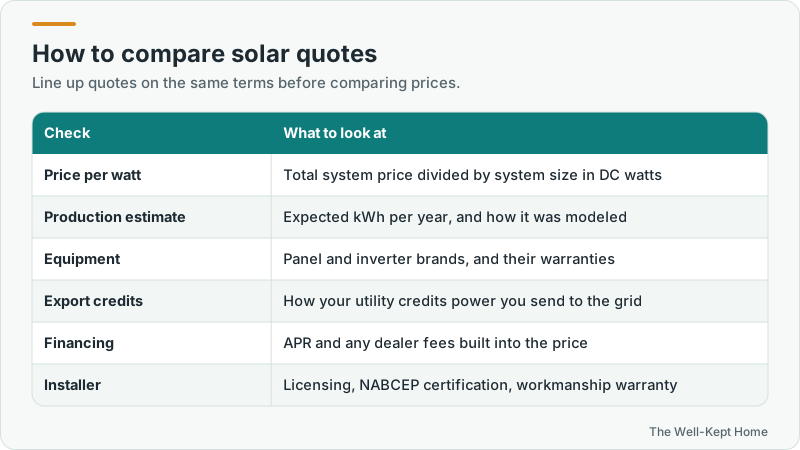
- Calculate price per watt: total price divided by system size in DC watts.
- Compare production estimates, and ask how they were modeled.
- Check equipment and warranties. Many panels carry 25-year performance warranties; inverters often have shorter ones.
- Understand your utility’s export rules and how they’re reflected in the savings estimate.
- Read financing terms carefully. Some solar loans include dealer fees built into the price, which make a “low APR” more expensive than it looks. Compare the cash price with the financed price.
- Check the installer. Look for licensing, NABCEP-certified staff, a workmanship warranty, and reviews of jobs at least a few years old.
- Look at your roof first. If it needs replacing within a few years, do that before installing panels.
Common questions
How long do solar panels last?
Panels commonly last 25 years or more, slowly producing a little less each year. Inverters may need replacement during the system’s life.
Should I add a battery?
Batteries provide backup power during outages and can increase savings where export credits are low or time-of-use rates are high. They add significantly to the cost, so weigh backup needs and your utility’s rules.
Can I still claim the 25D credit?
Only for qualifying expenditures made by December 31, 2025, claimed on the appropriate tax return. Systems paid for in 2026 don’t qualify. Check with a tax professional for your situation.