Shower glass restoration is a specialty service for glass that ordinary cleaning can’t fix: years of mineral buildup, a cloudy haze, and light etching. Done well, it can make a dull door look close to new for a fraction of what replacement glass costs. Done on the wrong glass, it’s money spent on a problem that better cleaning or new glass would have solved.
Here’s what the service involves, what it costs, and how to decide whether you need it.
Table of Contents
Restoration vs. cleaning
A regular cleaning removes what’s sitting on the glass. Restoration goes further. Technicians use stronger acid treatments to dissolve heavy, bonded deposits, then mechanically polish the glass, typically with cerium oxide and a rotary polisher, to reduce etching, the microscopic pitting in the glass surface itself. Most restorations finish with a protective coating so the glass stays clear longer.
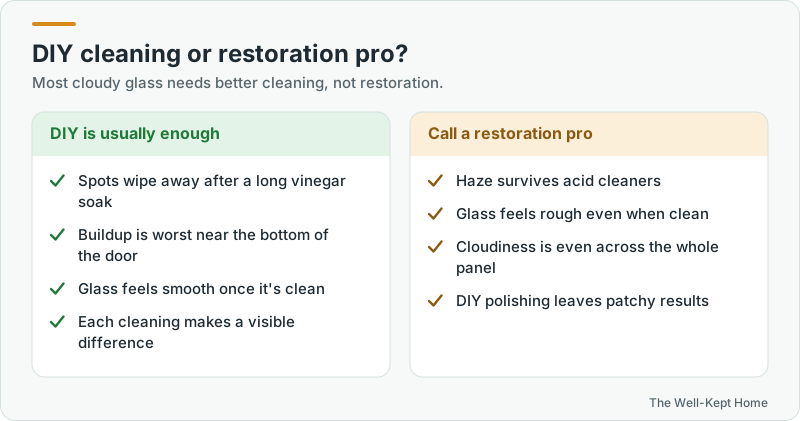
The important point: if your glass is only covered in buildup, you may not need a restoration service at all. Patient DIY cleaning often does the job, and our guide on removing hard water stains from shower doors walks through it.
Signs you need a restoration pro
- The haze survives two or more long vinegar soaks and an acid cleaner.
- The glass feels slightly rough or gritty even right after cleaning.
- The cloudiness is even across the whole panel rather than spotty.
- Spots look like they’re in the glass when you shine a flashlight across it at an angle.
- You’ve tried polishing it yourself and the results are patchy.
When restoration won’t help
- Deep scratches. Run a fingernail across the scratch. If the nail catches, the scratch is usually too deep to polish out without distorting the glass.
- Severe etching that has left the glass permanently frosted. Polishing can improve it, but the result may not justify the cost compared with new glass.
- Failing seals, chipped edges, or broken hardware. Those are repair or replacement jobs, not restoration.
What happens during a restoration visit
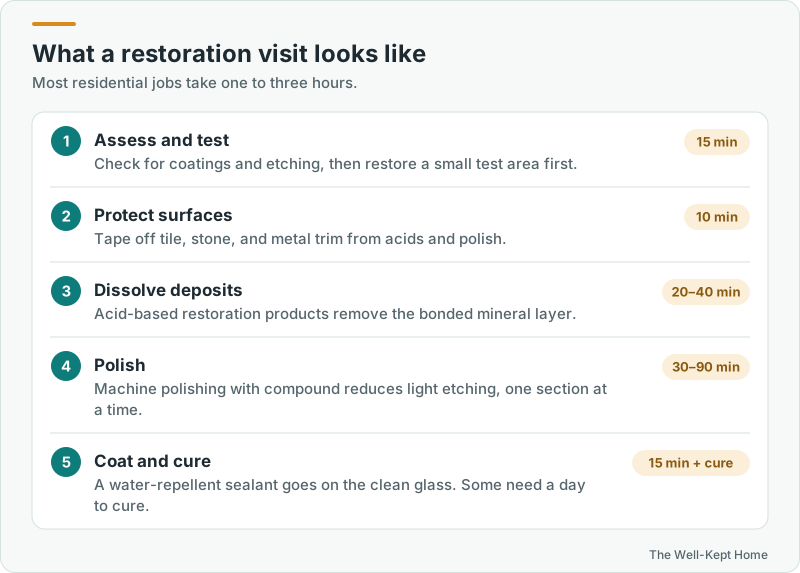
- Assessment. The technician inspects the glass, checks for an existing coating, and restores a small test area to show how much improvement is realistic. A good pro tells you up front if the glass is beyond saving.
- Surface protection. Tile, metal trim, and fixtures are taped off or covered, because restoration products can damage stone and specialty finishes.
- Deposit removal. Acid-based restoration products dissolve the mineral layer.
- Polishing. A polishing compound and machine pad work out light etching one section at a time, with the glass kept wet to control heat.
- Coating. A water-repellent sealant goes on the clean glass and is left to cure. Ask how long to wait before the first shower; some coatings need a full day.
- Aftercare. You should leave knowing which cleaners to use and which to avoid.
How much does shower glass restoration cost?
Pricing depends on your region, the size of the enclosure, and how bad the damage is. Many companies price per panel, and published residential rates commonly fall somewhere between about $100 and $500 per panel. Heavily etched glass and large or multi-panel enclosures sit at the top of that range. A protective coating may be included or listed separately.
Even at the high end, restoration usually costs much less than replacing tempered glass panels, which have to be custom-fabricated and installed. That gap is the main reason the service exists.
For an accurate quote, send clear photos of the glass taken at an angle with a flashlight, along with the panel dimensions. Many companies will give a rough price from photos and confirm it on site.
How to choose a restoration company
- Ask whether they specialize in glass. General cleaners and window washers vary a lot in restoration experience. Ask how many shower restorations they do and for before-and-after photos of their own work.
- Ask about a test spot. Reputable companies test first and set realistic expectations instead of promising “like new” on any glass.
- Ask what coating they use, how long it typically lasts, and whether it carries a warranty.
- Confirm they’re insured. They’ll be using acids and power tools around your tile and fixtures.
- Get the price in writing, including whether the coating is included and what happens if the results fall short.
Making the results last
Restoration resets the clock, but the same water will start the same process again. Squeegee after every shower, clean with gentle products, and follow the coating’s care instructions. Our guide to preventing hard water stains on shower glass covers the routine. If your water is very hard, price out a water softener before you pay for a second restoration.