That cloudy, chalky film on your shower door isn’t soap you missed. It’s mostly calcium and magnesium, left behind every time water dries on the glass. Each shower adds a thin layer, and after a few months the layers bond into spots that regular glass cleaner just smears around.
The fix is chemistry, not elbow grease. Mineral scale dissolves in mild acid, so plain white vinegar handles most doors. Heavier crust needs more contact time or a stronger acid, and a small number of doors have damage no cleaner can reverse. Here’s how to work through it in the right order.
Table of Contents
Two things to check before you start
Is the glass coated? Many newer shower doors have a factory-applied protective coating that makes water bead up and roll off. If your door came with care instructions, look for a coating name. Coated glass is fine with vinegar and soft sponges, but abrasive powders, scouring pads, and steel wool can wear the coating away.
Is it buildup or etching? Buildup sits on top of the glass. Etching is damage to the glass itself, caused by minerals and moisture sitting on the surface for years, and it can’t be cleaned off. You’ll find out which you have during the vinegar step: if the cloudiness doesn’t change after a long soak, etching is the likely culprit.
What you’ll need
- Distilled white vinegar (the standard 5% kind from the grocery store)
- A spray bottle and a microwave-safe cup
- Dish soap
- Paper towels or an old cotton rag
- A non-scratch sponge (blue or white, not the green scouring kind)
- Baking soda, for heavier spots
- A squeegee and a microfiber cloth
- Rubber gloves
The vinegar method, step by step
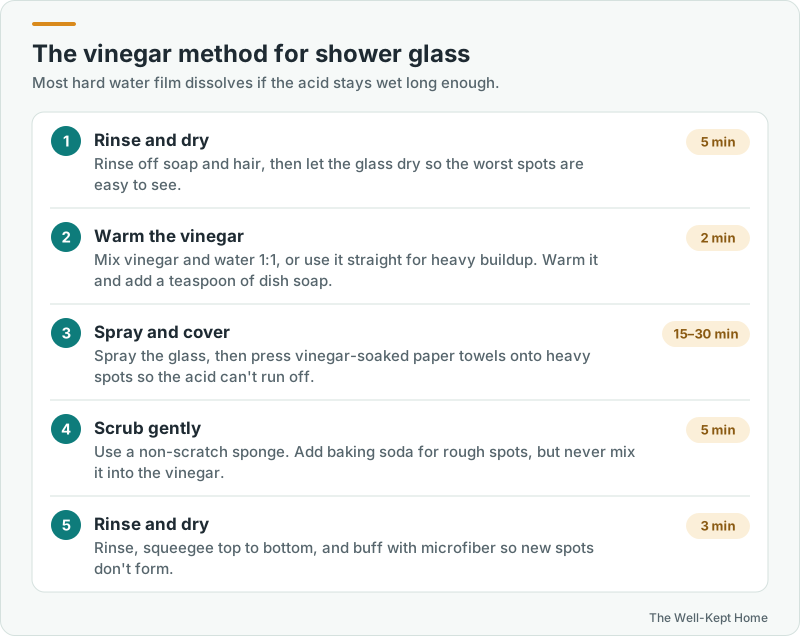
1. Rinse and let the door dry
Rinse the glass with warm water to remove loose soap and hair, then let it dry or wipe it dry. Dry glass under good light shows you exactly where the heavy spots are. They’re usually worst on the bottom third of the door and around the handle, where water lingers longest.
2. Warm the vinegar
Use equal parts vinegar and water for light film, or straight vinegar for heavy buildup. Warm it in a microwave-safe cup for 30 to 60 seconds, until it’s warm to the touch but not hot, then pour it into the spray bottle. Warm acid works noticeably faster than cold. Add a teaspoon of dish soap so the mix clings to vertical glass instead of running straight down.
3. Spray, then keep it wet
Spray the glass thoroughly. The step most people miss is contact time. Vinegar only works while it’s wet, and on a vertical surface it runs off or dries within minutes. Press vinegar-soaked paper towels against the worst areas; they’ll stick to the glass and hold the acid in place. Leave everything for 15 to 30 minutes, re-spraying if the towels start to dry.
4. Scrub gently
Peel off the towels and scrub with the non-scratch sponge in small circles. Softened deposits come off with light pressure. For spots that still feel rough, sprinkle baking soda onto the damp sponge and work it over the area. Baking soda is a soft abrasive that’s gentle on most glass. Use it after the vinegar, not mixed with it: combined in a bowl, the two neutralize each other into salty water.
5. Rinse, squeegee, and buff dry
Rinse with clean water, squeegee from top to bottom, and buff with a dry microfiber cloth. Don’t skip the drying. If the rinse water dries on the glass, it leaves fresh spots behind.
When vinegar isn’t enough
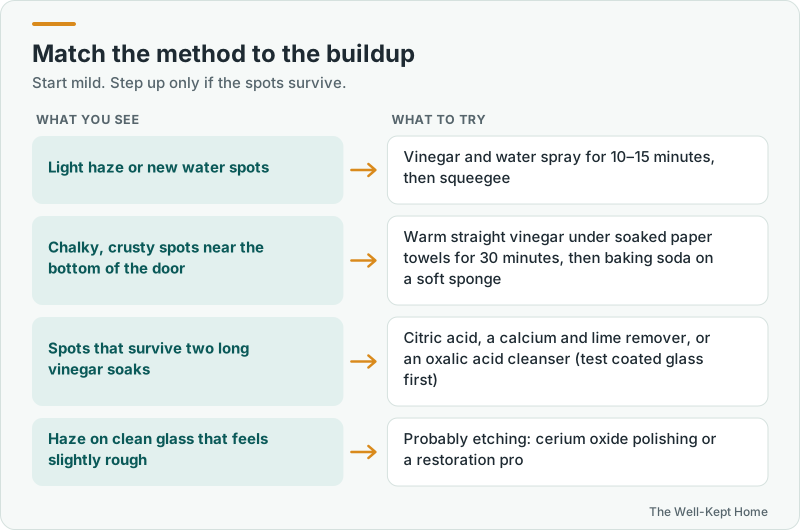
If two full 30-minute soaks haven’t done it, step up gradually:
- Citric acid. Dissolve about 2 tablespoons of citric acid powder (sold for canning and for descaling coffee makers) in 2 cups of hot water. It’s a stronger acid than vinegar and doesn’t smell.
- A calcium and lime remover such as CLR or Lime-A-Way. These work in minutes instead of half an hour. Follow the label’s contact time exactly, ventilate the room, and wear gloves. Keep them off natural stone and specialty metal finishes.
- An oxalic acid cleanser like Bar Keepers Friend Soft Cleanser. It pairs a mild acid with a fine polishing agent and works well on uncoated glass. Test a corner first if your door is coated.
Whatever you use, never combine an acidic cleaner with bleach or a bleach-based product. The mix releases chlorine gas, which is dangerous even in a ventilated bathroom.
What not to use on shower glass
- Razor blades. They’re a popular hack, but most shower doors are tempered glass, and the glass industry warns that scraping tempered glass can drag tiny surface particles across it and leave permanent scratches.
- Steel wool and green scouring pads, especially on coated glass.
- Bleach. It kills mildew but does nothing to mineral deposits.
- Dry powdered cleansers. If you use a cleanser, keep it wet and use light pressure.
If the cloudiness won’t come off
Glass that stays hazy after acid treatment, or feels slightly rough even when it’s perfectly clean, is probably etched. Light etching can sometimes be reduced by polishing with cerium oxide, the compound glass shops use to polish out fine scratches. It’s applied wet with a felt pad on a drill and takes patience; too much heat or pressure in one spot can leave a visible distortion. For a whole door, a shower glass restoration service is often the more practical route, and it’s still far cheaper than replacing the panel.
Keep it from coming back
The most effective habit is squeegeeing the glass after every shower. It takes about 20 seconds and removes the water before the minerals can settle. Run the exhaust fan, leave the door open to dry, and wipe the bottom track weekly. Our guide on how to prevent hard water stains on shower glass covers coatings, daily sprays, and whether a water softener is worth it.
Quick answers
How long should vinegar sit on hard water stains?
Fifteen to 30 minutes for most spots, as long as the glass stays wet. Covering the area with vinegar-soaked paper towels is what makes a long soak possible on a vertical door.
Does WD-40 remove hard water stains?
It can loosen light spots and leave a water-repellent film, but it’s a petroleum-based product that streaks, attracts grime, and can make a shower floor slippery if it drips. Vinegar is cheaper and doesn’t leave residue.
Will a Magic Eraser work?
Melamine sponges are a fine abrasive. They can lift light film, but used hard or often they can dull a protective coating. Use one gently, and only after an acid soak has softened the deposits.