Search for the best cleaner for hard water stains and you’ll find dozens of bottles promising a streak-free shine. Read the labels, though, and most of them fall into a handful of categories. The category tells you far more about how a product will perform than the brand name does.
Hard water stains are mineral deposits, mostly calcium carbonate. Anything that removes them does one of two things: dissolves the minerals with acid, or grinds them off with a fine abrasive. The best cleaner for your glass is the gentlest one that gets the job done, and that depends on how heavy the buildup is and whether the glass has a protective coating.
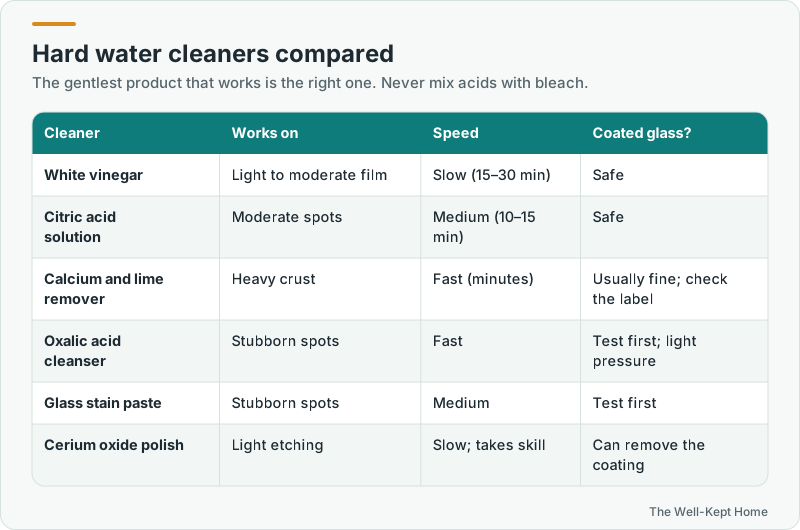
Table of Contents
The main options, from mildest to strongest
White vinegar
Household vinegar is about 5% acetic acid. It’s cheap, safe on nearly all glass and coatings, and good enough for light to moderate film. Its weakness is speed. On heavy spots vinegar needs 15 to 30 minutes of wet contact, which means covering the glass with soaked paper towels so it doesn’t run off. Warming it first helps, and the smell fades once the room airs out.
Best for: routine cleaning and light buildup.
Citric acid
Citric acid powder, sold for canning and for descaling coffee makers, is a stronger acid than vinegar and has no smell. About 2 tablespoons dissolved in 2 cups of hot water works noticeably faster than vinegar on the same stain. It’s also the active ingredient in plenty of “natural” descalers that charge more for the same chemistry.
Best for: moderate buildup when you want more power without harsh fumes.
Calcium, lime, and rust removers
Products like CLR and Lime-A-Way are formulated to dissolve mineral scale quickly. That speed is the reason to use them, and also the reason to be careful. Many have a short maximum contact time, often just a couple of minutes, so read the label before you start. Wear gloves, ventilate, and rinse thoroughly. Most warn against use on natural stone and some metals, which matters in a shower where glass meets tile and trim.
Best for: heavy, long-neglected deposits.
Oxalic acid cleansers
Bar Keepers Friend is the best-known example. Oxalic acid is effective on mineral and rust stains, and the cleanser formulas add a fine polishing powder. On uncoated glass it’s one of the most effective things you can buy at a hardware store. On coated glass the polishing powder is the concern, so use the liquid Soft Cleanser version with light pressure and test a small corner first.
Best for: stubborn spots on uncoated glass.
Glass stain removal pastes
Some products are made specifically for hard water on glass and rely on very fine abrasives in a paste. They’re popular with professional window cleaners because they work without strong acid fumes. They still remove material from the surface, though, so the same caution about coatings applies.
Cerium oxide polish
Cerium oxide isn’t really a cleaner. It’s a polishing compound that removes a microscopic layer of glass, and it’s what professionals reach for when a haze turns out to be etching rather than buildup. It’s applied wet with a felt pad, usually on a drill, and it takes time and care. Treat it as the last step before calling a glass restoration service.
What doesn’t work as well as people say
- Regular glass cleaner. Ammonia-based sprays are made for fingerprints and grease, not minerals. They make spotted glass look better for about an hour.
- Bleach. Good for mildew, useless on mineral deposits, and dangerous to combine with any of the acids above.
- Lemon juice. It contains citric acid, but less than a powder solution, and it leaves sugars behind.
- Toothpaste. A mild abrasive that can polish a small spot, but it’s slow and messy on a whole door.
How to tell if your shower glass is coated
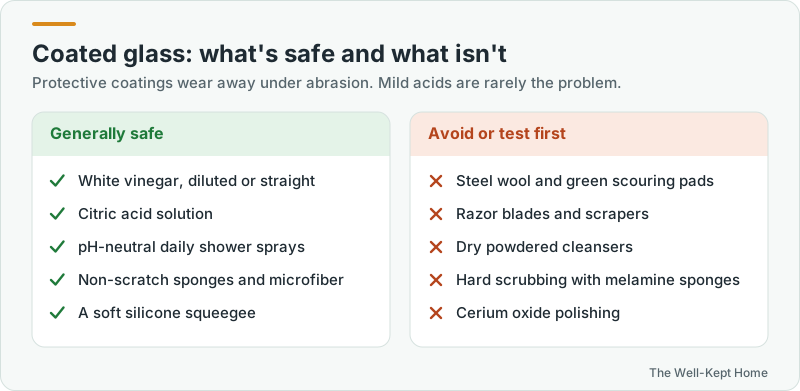
Start with the paperwork from your installer or the door manufacturer. Coatings are usually sold under a brand name and come with care instructions that are worth following. No paperwork? Clean a small patch thoroughly with vinegar, rinse, and watch the water. On most coated glass it beads up and runs off; on uncoated glass it spreads into a thin sheet. Heavy mineral film can hide a coating, so make sure the test patch is truly clean.
On coated glass, stick with vinegar, citric acid, and soft sponges. If a stronger product is unavoidable, use the gentlest version and the lightest pressure that works.
Which cleaner to use, by situation
- Weekly maintenance: a 1:1 vinegar and water spray, followed by a squeegee.
- Moderate spots: warm citric acid solution under paper towels for 15 minutes.
- Years of buildup on uncoated glass: a lime remover or an oxalic acid cleanser, then a thorough rinse.
- Haze that survives all of the above: probably etching. Polish it or get a professional opinion.
Whatever you choose, the result only lasts if the glass gets dried after showers. Our guide to preventing hard water stains on shower glass covers the habits and coatings that keep it clear. For the full step-by-step process, see how to remove hard water stains from glass shower doors.