Your HVAC filter is one of the cheapest parts of your heating and cooling system and one of the easiest to forget. It catches dust, lint, pet hair, and pollen before they reach the blower and coils, and it determines how freely air moves through the whole system. A clogged filter makes your furnace and air conditioner work harder, and it can cause real problems over time.
So how often should you change it? The common answer is every 90 days, but that’s only a starting point. The right schedule depends on the type of filter and on what’s going on in your home.
Table of Contents
The quick answer
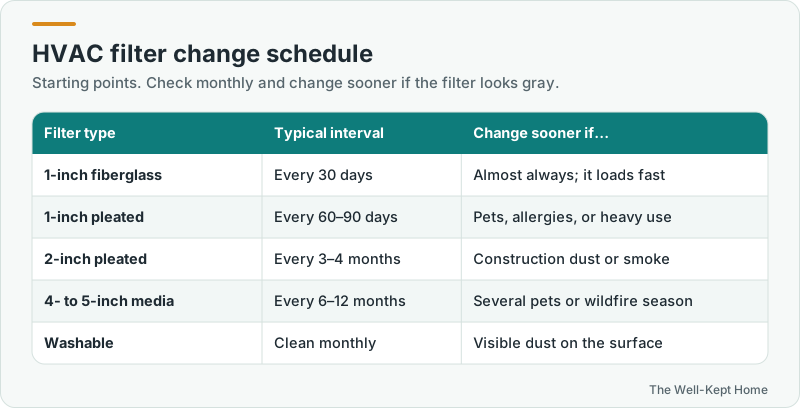
- 1-inch fiberglass filters: about every 30 days. They’re cheap and thin, and they load up fast.
- 1-inch pleated filters: every 60 to 90 days for most homes, and closer to 60 days with pets or allergies.
- 2-inch pleated filters: roughly every three to four months.
- 4- to 5-inch media filters: every 6 to 12 months. Their deep pleats hold much more dust.
- Washable or permanent filters: clean them monthly according to the manufacturer’s directions.
Always follow the filter maker’s or HVAC manufacturer’s recommendation if it’s different.
What makes filters clog faster
- Pets. Dogs and cats shed hair and dander constantly. With one pet, lean toward 60 days for a 1-inch pleated filter; with several, check it monthly.
- Allergies or asthma. A cleaner filter does its job better. Changing more often keeps capture high.
- Peak seasons. In the middle of summer or winter the system runs for many more hours, pulling more air through the filter.
- Renovations and construction. Drywall dust and sawdust can clog a filter in days. Check it weekly during dusty projects, and consider covering returns.
- Smoke. Wildfire smoke, indoor smoking, and heavy candle use all load filters faster.
- A full house. More people means more lint, skin flakes, and dust.
How to tell it’s time
Check the filter monthly until you know how fast it loads in your home. Pull it out and look at it in good light. A gray or brown coating across the surface, or dust so thick you can’t see the filter material, means it’s time. Other clues include more dust on furniture than usual, weaker airflow from the vents, and the system running longer to reach the set temperature.
What happens if you don’t change it
A clogged filter restricts airflow. In cooling mode, that can make the indoor coil so cold that it freezes over, which stops cooling and can lead to water leaks. In heating mode, it can make a furnace overheat and shut down on its safety limit switch. Either way, the system works harder and uses more energy. The U.S. Department of Energy says replacing a dirty, clogged filter with a clean one can lower an air conditioner’s energy use by 5% to 15%.
Where to find your filter
Most homes have the filter in one of two places:
- Behind a return air grille on a wall or ceiling. It’s usually a large grille with no airflow coming out of it. Some homes have several returns, each with its own filter.
- In a slot at the furnace or air handler, often with a removable cover.
How to change it
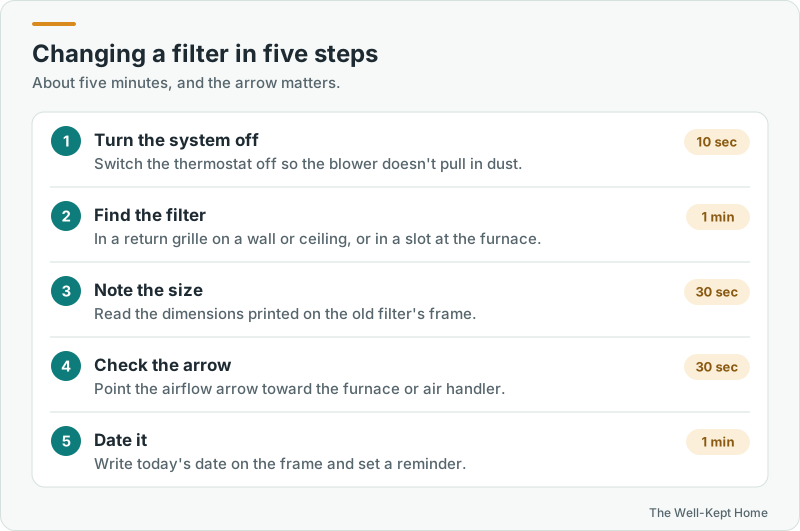
- Turn the system off at the thermostat.
- Remove the old filter and note the size printed on its frame. If there’s no label, see how to find your air filter size.
- Check the airflow arrow on the new filter. It should point toward the furnace or air handler, in the direction the air moves.
- Slide the new filter in so it fits snugly with no gaps around the edges.
- Write the date on the frame, turn the system back on, and set a phone reminder for the next change.
Tips that make it easier
- Buy filters in multipacks so you always have a spare.
- Many smart thermostats can remind you when it’s time.
- Choose the right efficiency for your home. Our comparison of MERV 8 vs. MERV 11 filters explains the difference.
- Never run the system without a filter, even for a day. Dust goes straight onto the coil and blower.
Common questions
Can I go six months with a 1-inch filter?
Usually not. A 1-inch filter is likely to be clogged long before six months in a lived-in home. Thick media filters are the ones designed for six- to twelve-month intervals.
Do more expensive filters last longer?
Not necessarily. Higher-efficiency filters capture more fine particles, which can make them load up sooner. Price and efficiency don’t extend the schedule; thickness does.
Can I wash and reuse a disposable filter?
No. Water damages disposable filter media and can promote mold growth. Only filters labeled washable should be cleaned and reused.