If your dishwasher has started leaving gritty residue on glasses, smelling bad, or draining slowly, the filter is the first place to look. Plenty of people don’t know their dishwasher has one. Older machines often used a built-in grinder that chopped up food debris, but most dishwashers sold in roughly the last decade use a manual filter instead. It’s quieter and more efficient, and it needs you to clean it.
Table of Contents
Where to find the filter
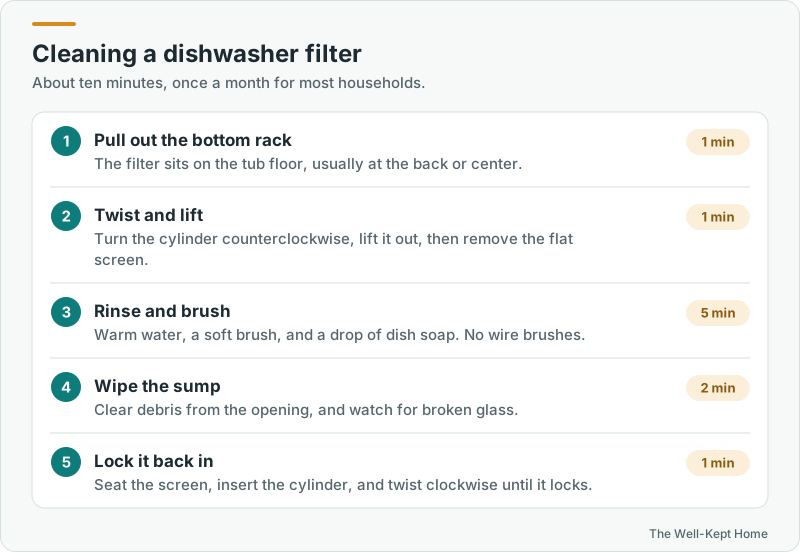
Pull out the bottom rack. On the floor of the tub, usually at the back or in the center, you’ll see a round cylinder with a handle or tabs on top, sitting in a flat mesh screen. That’s the filter assembly. On most models the cylinder twists counterclockwise about a quarter turn and lifts out, and the flat screen lifts out after it. Some brands use a single piece. If you’re unsure, the manual has a diagram.
How to clean it
- Remove the bottom rack for easy access.
- Twist and lift out the cylindrical filter, then lift out the flat mesh screen if it’s separate.
- Rinse both under warm running water. Most loose food washes right off.
- Scrub gently with a soft brush and a drop of dish soap. An old toothbrush is perfect. Don’t use a wire brush or scouring pad, since the fine mesh is easy to damage.
- Soak stubborn grease. If the mesh is coated in greasy film, soak it in hot, soapy water for 10 minutes, then scrub again.
- Wipe out the sump. With the filter out, wipe the opening it sits in with a damp paper towel to pick up debris. Go carefully, because broken glass ends up here.
- Reinstall it properly. Set the flat screen back in place, insert the cylinder, and twist it clockwise until it locks. A filter that isn’t locked in can let debris reach the pump.
How often to clean it
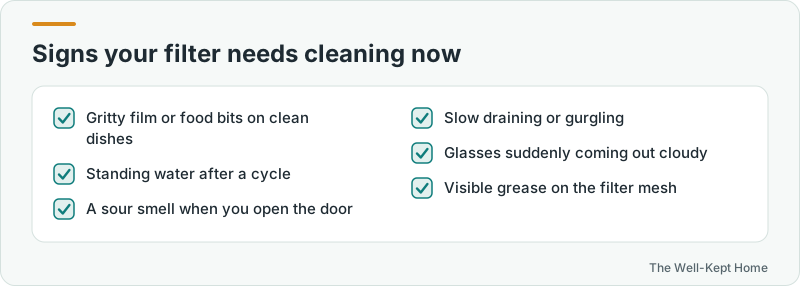
Manufacturers generally suggest checking the filter about once a month, and more often if you run the dishwasher daily, rarely scrape plates, or cook a lot of greasy or starchy food. If you notice any of the warning signs below, clean it right away.
While you’re at it: a full dishwasher refresh
A clean filter fixes most problems, but a few other parts collect gunk too:
- Spray arms. Look for clogged holes. Most arms pop or unscrew off. Clear the holes with a toothpick, rinse, and reinstall.
- Door gasket and edges. Wipe the rubber seal and the bottom edge of the door, where drips and food collect, with a damp cloth.
- Cleaning cycle. Run a dishwasher cleaner through an empty hot cycle. Many people put a cup of white vinegar on the top rack instead. That works on hard water film, but check your manual, since some manufacturers prefer their own cleaners.
- Hard water film. If glasses come out cloudy, use a rinse aid and check whether your detergent is formulated for hard water.
Why the filter matters so much
The filter keeps food particles from being sprayed back onto your dishes, and it protects the drain pump from debris. When it clogs, water can’t circulate or drain properly. You get dirty dishes, standing water, odors, and extra strain on the pump. Ten minutes a month prevents a large share of the service calls dishwashers get for “not cleaning” or “not draining.”
Do you still need to rinse dishes?
Scrape, don’t rinse. Scrape solid food into the trash or compost and let the dishwasher handle the rest. Detergent makers point out that their enzymes are designed to work on food soil, and the filter is built to catch small particles. What clogs filters and damages pumps is the big stuff: bones, fruit pits, labels, toothpicks, and large scraps.
When the problem isn’t the filter
If the filter is clean and the dishwasher still won’t drain, check the drain hose under the sink for kinks, and check the garbage disposal connection. If the disposal is new, the knockout plug inside its dishwasher inlet may never have been removed, which blocks drainage completely. A pump that hums without moving water, or error codes that keep coming back, are jobs for an appliance technician.
Common questions
Can I run the filter through the dishwasher to clean it?
No. Wash it by hand. A cycle can’t scrub the fine mesh, and running the machine without the filter in place lets debris reach the pump.
What if my dishwasher doesn’t seem to have a removable filter?
Some older models use a self-cleaning system with a built-in grinder, and a few designs hide the filter under a cover. Check the manual, or search your model number online for a diagram.
My filter is cracked. Can I keep using it?
Replace it. A torn mesh lets food particles through to the pump and back onto your dishes. Replacement filters are inexpensive and are usually sold by model number.
The dishwasher is one of several appliances that quietly collect grime. For the rest of the kitchen, see our guides to cleaning an oven without harsh chemicals and cleaning refrigerator coils.