If you’re scrubbing white crust off faucets every week, replacing showerheads that clog, or hearing your water heater pop and rumble, you’ve probably started pricing out a water softener. Installation is straightforward for a licensed plumber, but quotes vary widely from one company to the next. Some of that difference is the equipment. Some of it is sales technique.
Here’s what drives the cost, how to size a system before anyone quotes you, and what to ask local installers.
Table of Contents
First, confirm you actually have hard water
Water hardness is measured in grains per gallon (gpg) or milligrams per liter (mg/L). One grain per gallon is about 17.1 mg/L. Using the U.S. Geological Survey’s general classification:
- Under 3.5 gpg: soft. You don’t need a softener.
- 3.5 to 7 gpg: moderately hard. Some spotting; a softener is optional.
- 7 to 10.5 gpg: hard. Scale and spots are noticeable.
- Over 10.5 gpg: very hard. A softener usually makes a clear difference.
On city water, your utility’s annual water quality report, often called a Consumer Confidence Report, frequently lists hardness, and if it doesn’t, the utility can usually tell you. On a private well, test with inexpensive strips or send a sample to a lab. Be wary of free in-home water tests offered by companies that sell softeners; they’re often the start of a sales pitch.
How much does water softener installation cost?
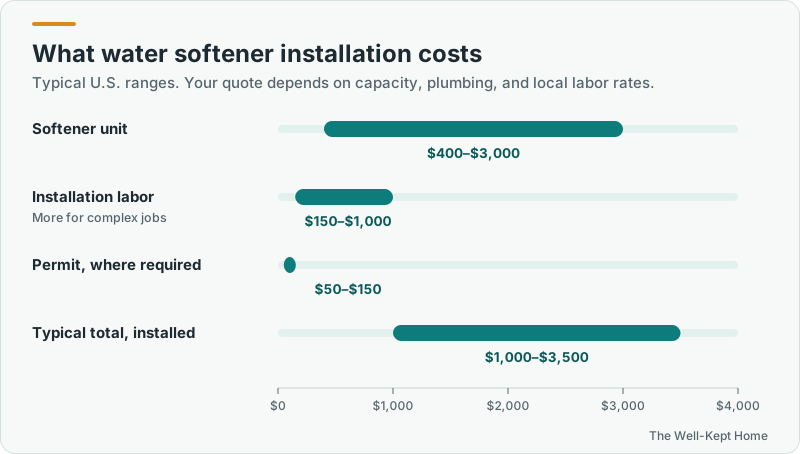
Most homeowners spend somewhere around $1,000 to $3,500 for a softener with professional installation, and many standard jobs land in the middle of that range. The total breaks down into a few parts:
- The unit: roughly $400 to $3,000, depending on capacity, the control valve, and the brand. Dealer-only brands sit at the top of the range.
- Labor: roughly $150 to $1,000 for a typical install, more for complex jobs. If your home has a pre-plumbed softener loop, installation is simpler and cheaper. If the plumber has to run new lines, add a drain, or install an outlet, expect to pay more.
- Permits: required in some areas, often about $50 to $150.
- Extras: a sediment pre-filter (common on well water), a separate drinking water filter, or removal of an old unit.
Ongoing costs are modest but real: salt, occasional service, and eventually new resin, which usually lasts many years.
Size it before you shop
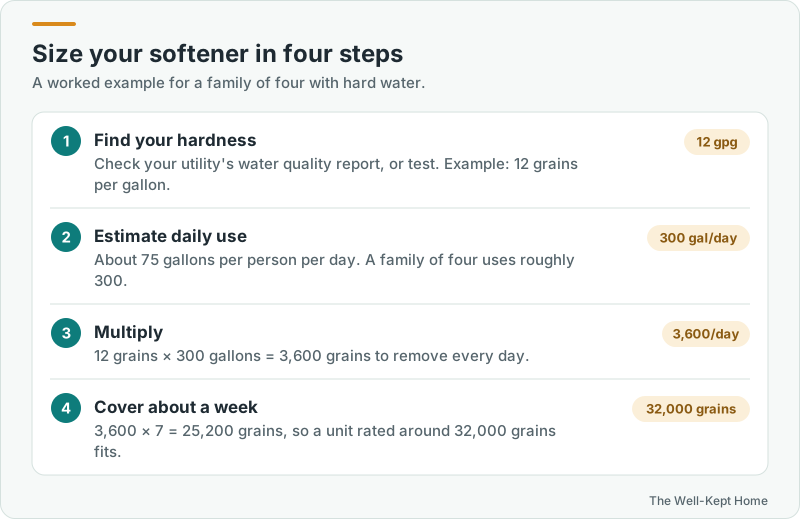
An undersized softener regenerates too often and wastes salt and water. An oversized one costs more up front for capacity you won’t use. You can estimate the right size yourself:
- Find your hardness in grains per gallon. If your water also contains iron, many installers add a few grains for each part per million of iron.
- Estimate daily water use. A common rule of thumb is about 75 gallons per person per day.
- Multiply hardness by daily use to get the grains removed per day. A family of four using 300 gallons a day at 12 gpg needs to remove 3,600 grains a day.
- Plan for about a week between regenerations. 3,600 × 7 = 25,200 grains, so a unit rated around 32,000 grains is a sensible fit.
Keep in mind that a softener’s rated capacity assumes its maximum salt setting. Run at a more salt-efficient setting, it delivers less, which is why installers often size up slightly. Bring your own estimate to every quote. If someone recommends something much larger without a clear reason, ask why.
Salt-based softener or salt-free conditioner?
Salt-based softeners are what most people mean by a water softener. Resin beads trade calcium and magnesium for sodium, or potassium if you use potassium chloride pellets. The system periodically rinses the resin with brine and sends that rinse down a drain. This is the only type that actually removes hardness, so it’s the one that stops spots on glass and scale in fixtures. Look for certification to NSF/ANSI 44, the standard for residential softeners.
Salt-free conditioners, often using a process called template-assisted crystallization, don’t remove hardness minerals. They change how the minerals behave so they’re less likely to form hard scale inside pipes and water heaters. They need no salt, drain, or electricity, but they won’t stop water spots on glass and dishes the way a softener does.
Two more things to know:
- A few communities, mostly in parts of California, restrict softeners that discharge salt into the sewer. Check with a local plumber or your city before you buy.
- Softened water contains a small amount of added sodium. If someone in the house is on a low-sodium diet, consider potassium chloride or keep one unsoftened tap for drinking water.
What a proper installation includes
- Placement where the main line enters the house, after the main shutoff and before the water heater
- A bypass valve, so the softener can be serviced without shutting off water to the house
- A drain line with an air gap, which plumbing codes generally require to prevent backflow
- Outdoor hose bibs usually left on hard water, so you aren’t paying to soften water for the lawn
- Programming for your hardness and household size, plus a walkthrough of salt refills and settings
Questions to ask local installers
- Are you a licensed plumber, or do you subcontract the installation?
- What size do you recommend, and how did you calculate it?
- Is the unit certified to NSF/ANSI 44? What’s the warranty on the tank, the resin, and the control valve?
- Does this job need a permit, and is it in the quote?
- Can I buy salt and replacement parts anywhere, or only from you?
- What’s the total price in writing, including removal of any old unit?
Get at least two quotes, ideally one from an independent plumber and one from a water treatment dealer. Dealers often bundle service plans and proprietary parts, which suits some households, but weigh that against the long-term cost.
Once the water is softer, cleaning gets easier too. Spots can still form if water dries on glass, but they wipe away instead of building up. Our guide on preventing hard water stains on shower glass covers the rest of the routine.