Most energy advice assumes you own your home: add insulation, replace the windows, upgrade the furnace. Renters can’t do any of that. But apartment dwellers still control a lot of their energy use, including how they heat and cool, what they plug in, how they do laundry, and how much sunlight they let in. And because apartments are usually smaller and share walls with neighbors, renters often start with an efficiency advantage.
Here’s what you can do on your own, and what’s worth asking your landlord to fix.
Table of Contents
Heating and cooling
- Use DOE’s thermostat guidelines as a starting point: about 78°F when you’re home in summer and 68°F when you’re awake in winter, with larger setbacks when you’re out or asleep. See the best thermostat setting for summer.
- Use fans. A ceiling or pedestal fan lets you set the thermostat higher in summer. Turn fans off when you leave the room.
- Manage sunlight. Close blinds on sun-facing windows in summer afternoons; open them on sunny winter days and close them at night.
- Maintain window units. Clean the filter monthly during cooling season, seal gaps around the unit with foam, and cool only the rooms you’re using.
- Be wary of portable air conditioners. Single-hose portable units are generally less efficient than window units of similar capacity.
- Use space heaters carefully. They can save money if you heat one room and lower the thermostat, but follow every safety rule; see lowering your heating bill in winter.
Stop drafts without tools
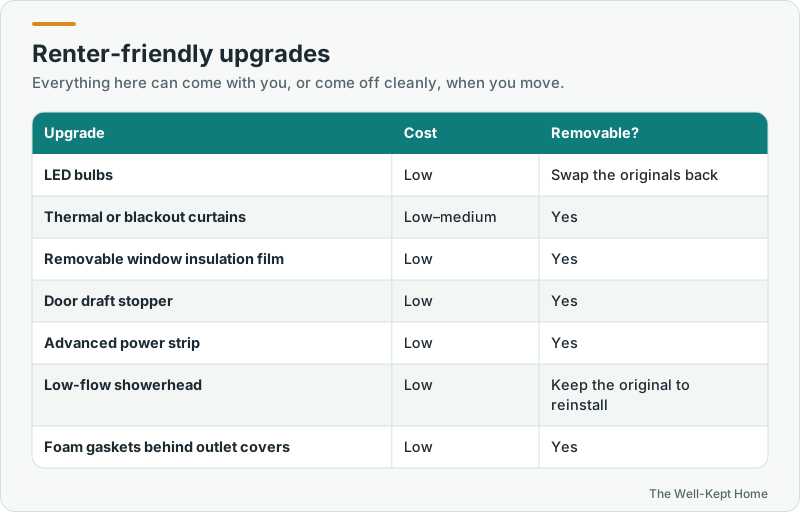
- Door draft stoppers along the bottom of exterior doors
- Removable window insulation film, which shrinks tight with a hair dryer and peels off in spring
- Removable weatherstripping tape on drafty windows
- Foam gaskets behind outlet and switch covers on exterior walls
- Thermal curtains on large windows
Lighting and electronics
- Switch to LED bulbs. Keep the original bulbs in a box and swap them back when you move out, taking your LEDs with you.
- Use an advanced power strip for the TV and gaming setup, so accessories turn off with the main device.
- Change console and TV settings from instant-on to energy-saving modes.
- See how to reduce phantom power usage for more.
Laundry and kitchen
- Wash in cold water. The U.S. Department of Energy notes that heating water accounts for the large majority of the energy a washing machine uses. Modern detergents clean well in cold water.
- Run full loads in the washer and dishwasher.
- Air-dry clothes when you can, or at least clean the dryer’s lint screen every load.
- Keep the fridge at 37°F to 40°F and the freezer at 0°F. Colder than that wastes energy.
- Use the microwave or a countertop appliance for small meals instead of heating a full oven.
Hot water
- Take shorter showers.
- Install a low-flow showerhead. Keep the original to reinstall when you move.
- Report dripping hot water faucets. A steady drip wastes both water and the energy that heated it.
What to ask your landlord
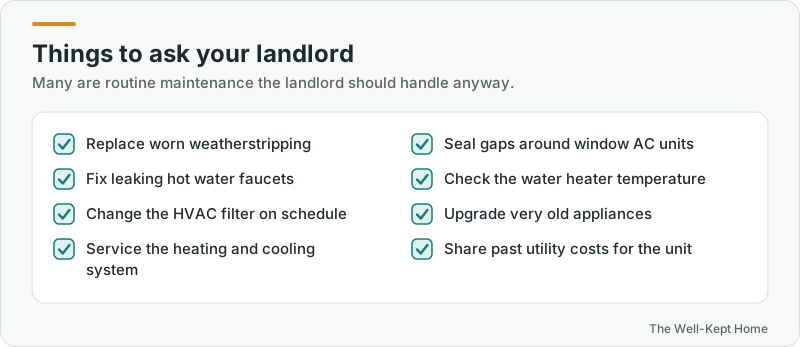
Many energy fixes are routine maintenance, and landlords often handle them when asked, especially in writing:
- Replacing worn weatherstripping on doors and windows
- Fixing leaking faucets and running toilets
- Changing the HVAC filter on schedule and servicing the system
- Sealing gaps around wall or window AC units
- Upgrading very old, inefficient appliances when they need replacing
Before you sign a lease, it’s reasonable to ask about typical utility costs for the unit. Some cities require landlords to disclose energy information.
Use your utility’s programs
- Free energy-saving kits with LED bulbs, power strips, or showerheads, offered by many utilities
- Budget billing, which evens out seasonal spikes
- Time-of-use plans, if you can shift laundry and dishes to off-peak hours
- Community solar, available in some states, which lets renters subscribe to a share of a solar project and receive bill credits
- Bill assistance through the Low Income Home Energy Assistance Program (LIHEAP) for eligible households
A move-in checklist for renters
- Find the thermostat type and set a schedule on day one.
- Check window and door seals for drafts and report problems early, in writing.
- Look at the water heater setting if it’s accessible; 120°F is plenty for most households.
- Find out whether heat and hot water are included in the rent or on your bill, and whether they’re gas or electric.
- Swap the most-used bulbs for LEDs.
- Set up an online account with your utility so you can track usage from the first bill.
Common questions
Do apartments use less energy than houses?
Usually, yes. They’re smaller and share walls, floors, and ceilings with heated or cooled neighbors, which reduces heat loss and gain.
Can I install a smart thermostat as a renter?
Only with your landlord’s permission. Keep the original thermostat to reinstall when you move. See smart thermostat installation.
Why is my apartment’s bill so high when I’m barely home?
Common causes include electric heat, an old refrigerator, a water heater that’s set too hot, or a rate change. See why your electric bill is suddenly high.