Hiring a cleaning service is a classic household trade-off: money for time. For some families it’s one of the best things they spend money on. For others it feels like a luxury they’d rather skip. There’s no universal answer, but there is a sensible way to think it through: look at the real yearly cost, the time it gives back, the stress it removes, and the middle-ground options that can deliver much of the benefit for less.
Table of Contents
Start with the yearly cost
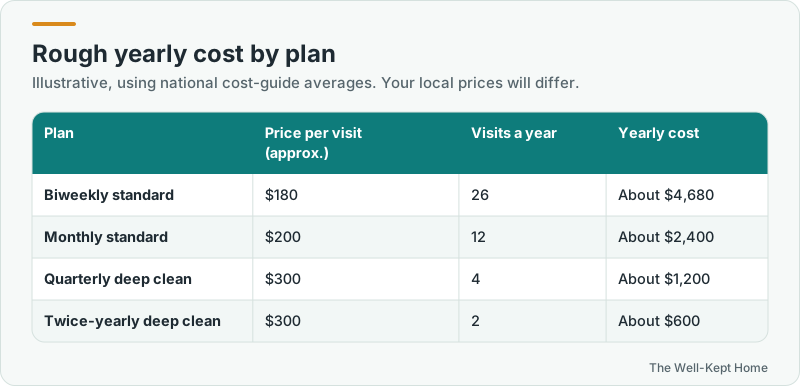
A per-visit price can feel small or large depending on how you look at it, so it helps to annualize. Using national cost-guide averages as a rough guide, a biweekly standard clean at around $180 a visit adds up to about $4,680 a year. A monthly clean at around $200 is about $2,400 a year. A quarterly deep clean at around $300 is about $1,200 a year. Your local prices will differ, sometimes a lot, so plug in real quotes. See house cleaning prices for typical ranges.
Then look at the time
Estimate honestly how much time your household spends cleaning each week, including the big jobs you put off. A professional team often does in two or three hours what takes a household much longer, because they’re practiced, equipped, and focused. Then ask what you’d do with those hours: rest, time with kids, exercise, work, or simply less rushing.
One rough way to compare: divide the yearly cost by the hours it saves you. If biweekly cleaning saves you four hours per visit, that’s about 104 hours a year. At about $4,680 a year, that’s about $45 per hour of your time saved. Whether that’s worth it depends on your budget and what those hours mean to you.
Don’t ignore the stress factor
Money and time aren’t the only factors. For many households, the biggest benefit is fewer arguments about chores, less background stress about a messy home, and feeling ready when people come over. That’s hard to put a number on, but people who use cleaning services often name it as the main reason they keep it.
Who benefits most
- Busy households where everyone works long hours
- New parents, caregivers, and anyone recovering from illness or surgery
- People with physical limitations, allergies, or asthma
- Pet owners fighting a constant battle with hair and dander
- Couples or roommates who argue about chores
- People who host often or work from home and want a consistently clean space
When it may not be worth it
- The cost would strain your budget or crowd out savings.
- Your home is small and easy to keep up.
- You genuinely enjoy cleaning, or find it relaxing.
- You’re uncomfortable with someone else in your home.
Middle-ground options
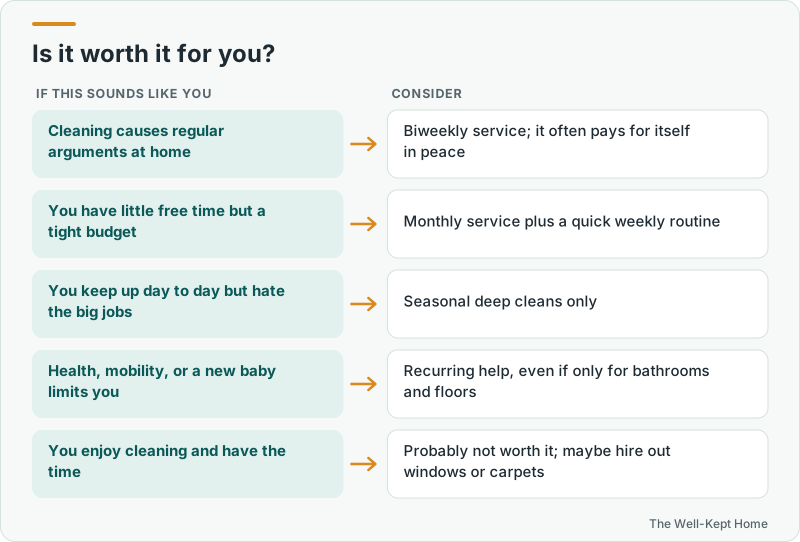
- Monthly service plus a quick weekly routine. A professional handles the deep work; you keep bathrooms and the kitchen tidy in between.
- Bathrooms and floors only. Some cleaners will focus on the jobs you dislike most, which shortens visits and lowers cost.
- Seasonal deep cleans. Two to four a year, with your own upkeep between them; see deep cleaning services.
- Specialty services only. Hire out the jobs that are hard or unsafe to DIY, such as windows, carpets, and the oven, and do the rest yourself.
Questions to ask yourself
- How many hours a week does cleaning take now, including the jobs I keep putting off?
- What would I do with that time, and what is it worth to me?
- Is cleaning a regular source of conflict at home?
- Which tasks do I dislike most, and could I hire out only those?
- Does the cost fit comfortably in the budget without cutting into savings?
- Am I comfortable with someone in my home and with sharing access?
Try before you commit
If you’re unsure, book a one-time deep clean or two or three recurring visits. Pay attention to how the house feels, how much time you get back, and whether the quality matches the price. Most residential services don’t require long contracts, so a short trial is an easy way to answer the question with real experience rather than guesses. See one-time house cleaning.
Getting the most value if you do hire
- Choose the right frequency; see recurring house cleaning.
- Agree on a clear checklist so the time goes where you want it.
- Declutter before visits.
- Give specific feedback early.
- Keep the same cleaner or team if they’re good. Consistency saves time and improves results.
Common questions
Is a cleaning service only for wealthy people?
No. Many middle-income households use monthly or occasional cleaning as a targeted expense, the way they might pay for lawn care or meal kits.
How often do most people book?
Biweekly service is the most popular choice for recurring cleaning. Monthly and one-time deep cleans are common too.
What if I try it and don’t like it?
Most residential services don’t require long contracts. Try a one-time clean first, or a few recurring visits, before committing.
Should I budget for tips?
If you use a regular cleaner, yes. See how much to tip house cleaners.