When you’re choosing someone to clean your home, reviews are often the best evidence you have. But a 4.8-star average tells you surprisingly little on its own. It doesn’t tell you whether the company is reliable this year, whether its cleaners stay long enough to learn your home, or how it handles a broken vase. And some reviews aren’t what they appear to be. Here’s how to read house cleaning reviews like a skeptic, and how to write one that actually helps the next person.
Table of Contents
Where to read reviews
Check more than one source, since each platform has its own quirks:
- Map listings such as Google Business Profiles, which often have the most reviews.
- Dedicated review sites, some of which filter reviews they consider less reliable.
- Neighborhood apps and local social media groups, where neighbors tend to be candid and specific.
- The Better Business Bureau, which is useful for seeing formal complaints and how companies responded.
- Home services marketplaces and booking apps, where reviews are usually tied to verified bookings.
A company with solid reviews on several independent platforms is a much safer bet than one that looks perfect on just one.
What good reviews tell you
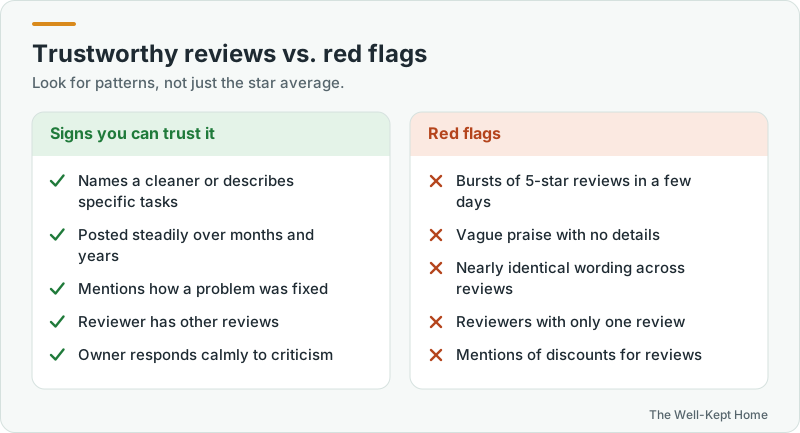
- Specific details. Reviews that name a cleaner, describe what was cleaned, or mention a particular problem that was handled well are far more credible than “Great service!”
- Consistency over time. A steady stream of positive reviews over months and years suggests the company maintains its standards through staff changes.
- Reliability. Look for mentions of on-time arrivals, the same team each visit, and good communication. For recurring cleaning, these matter as much as cleaning quality.
- Problem resolution. Reviews that say “they missed the baseboards, but came back the next day” tell you more about a company than a dozen generic five-star ratings.
How to read negative reviews
Every company gets an occasional bad review. What matters is the pattern:
- Repeated themes are a real warning: no-shows, rushed cleanings, damage that wasn’t handled, surprise charges, or constantly changing cleaners.
- Recency matters. A cluster of complaints in the last few months may mean new ownership or staffing problems.
- Owner responses reveal a lot. A calm, specific reply that offers a fix is a good sign. Defensive or hostile replies are not.
- Relevance. A complaint about commercial cleaning may not matter if you need a recurring home clean.
Spotting fake or unreliable reviews
Fake reviews exist in every industry. Since October 2024, a Federal Trade Commission rule has prohibited businesses from buying fake reviews, paying for positive or negative reviews conditioned on sentiment, and suppressing negative reviews. Enforcement doesn’t catch everything, so watch for:
- Bursts of five-star reviews posted within a few days
- Generic praise without any details about the service
- Similar wording across many reviews
- Reviewers with no other reviews, or reviews spread across unrelated businesses in different cities
- Reviews mentioning a discount or freebie in exchange for the review
- A sudden wave of one-star reviews that sound coordinated, which can be a competitor attack
Vetting a company’s reviews quickly
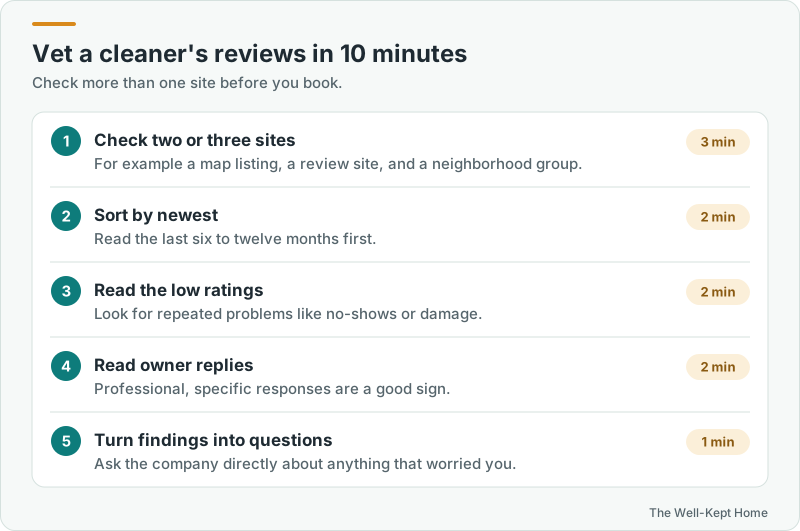
- Check two or three independent sites.
- Sort by newest and read the last six to twelve months.
- Read the lowest ratings and look for repeated problems.
- Read how the owner responds.
- Turn anything that worried you into a direct question for the company.
What reviews can’t tell you
Reviews rarely mention insurance, background checks, how cleaners are paid and trained, or the exact cancellation policy. Ask those questions directly. Our guide to finding and vetting a house cleaning service lists what to ask, and how to tell which companies are actually good covers the traits that matter.
Writing a review that helps others
- Be specific: the type of service, how long they’ve cleaned for you, what went well, and what didn’t.
- Be fair. Give the company a chance to fix a problem before posting, and update your review if they do.
- Mention cleaners by first name if they did great work. It often matters to them and their employer.
- Leave out personal details about the cleaners and anything about your home’s security, such as entry codes or schedules.
Common questions
How many reviews should a good cleaning company have?
There’s no magic number. A newer company may have few reviews but strong ones. What matters more is consistency, specificity, and recency relative to how long the company has been operating.
Should I trust reviews on the company’s own website?
Treat them as testimonials the company chose to show. Independent platforms give a more complete picture.
Is a 4.5-star rating bad?
Not at all. A mix of mostly positive reviews with a few honest criticisms can be more believable than a perfect score. Read what the lower ratings say.
What if I see good and terrible reviews about the same company?
Look at dates and details. Quality may depend on which team or cleaner you get. Ask the company how they keep standards consistent and whether you can request a specific team.