Air duct cleaning is one of those services that’s genuinely useful in some situations and heavily oversold in others. Done properly, it removes accumulated debris, mold, or pest contamination from your heating and cooling system. Done badly, or sold as a cheap special, it can be a waste of money. Here’s when it makes sense, what a proper job looks like, and how to tell a good company from a bad one.
Table of Contents
When duct cleaning makes sense
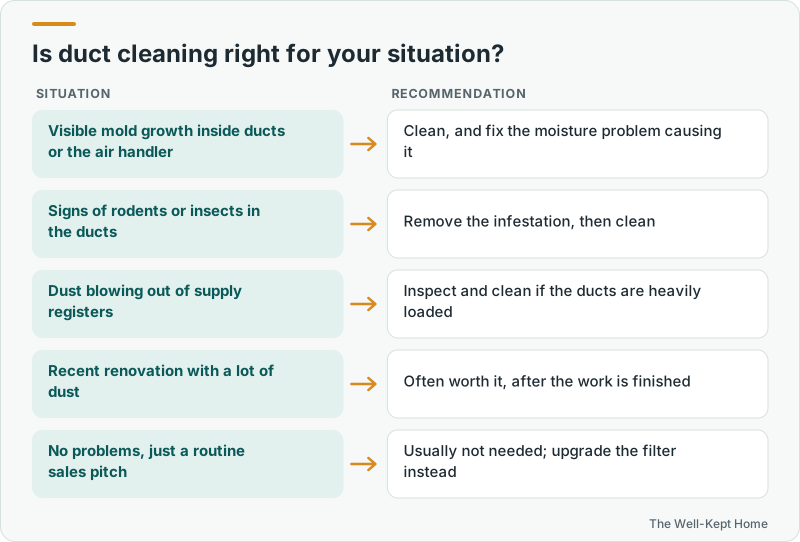
The U.S. Environmental Protection Agency suggests considering duct cleaning in specific situations:
- Substantial visible mold growth inside hard-surface ducts or on other parts of the heating and cooling system.
- Vermin infestation, such as rodents or insects, in the ducts.
- Ducts clogged with excessive dust and debris, to the point where particles are released into the home from the supply registers.
Other situations where cleaning is often reasonable include the end of a major, dusty renovation, smoke damage after a fire, and moving into a home where the system was neglected for years.
If none of these apply, routine duct cleaning usually isn’t necessary. The EPA notes that duct cleaning has never been shown to actually prevent health problems. Our guide to whether air duct cleaning is worth it goes deeper into the evidence.
What a proper duct cleaning includes
The industry approach, known as source removal, uses two things at once: negative pressure from a powerful vacuum connected to the duct system, and agitation from brushes, air whips, or compressed air tools that loosen debris so the vacuum can pull it out. A complete job covers:
- All supply and return ducts, not just the vent covers
- Registers, grilles, and diffusers
- The supply and return plenums
- The blower compartment and blower
- The coil and drain pan, where accessible, often handled with the HVAC contractor
- Inspection before and after, ideally with photos or video
Cleaning only part of the system can lead to recontamination. For an average-sized home, a thorough job usually takes several hours.
Sanitizers and coatings
Some companies offer to spray biocides or sealants inside the ducts. The EPA advises caution here: any chemical treatment should be applied only after the system is properly cleaned, only if it’s actually needed, and only with a product registered by the EPA for use in HVAC systems. Ask what product would be used and why before agreeing to it.
What it costs
Commonly cited figures put proper cleaning of an entire duct system in an average-sized home at roughly $450 to $1,000, depending on the size of the system, the number of vents, accessibility, and the level of contamination. Mold remediation or pest cleanup adds to the cost.
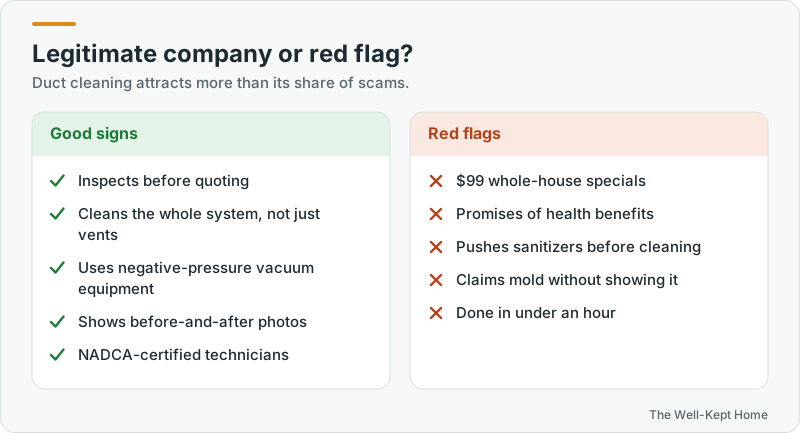
Be especially wary of “$99 whole-house” specials. The National Air Duct Cleaners Association (NADCA) warns homeowners about these offers, which often turn into much higher bills once the crew arrives, or into a quick vacuum of the vent covers.
How to choose a company
- Look for NADCA membership and certification. NADCA certifies technicians as Air Systems Cleaning Specialists. The EPA doesn’t certify or endorse duct cleaning companies.
- Ask for an inspection first, with photos or video showing what’s in your ducts.
- Get a written scope and price that lists every component to be cleaned.
- Confirm the equipment: negative-pressure vacuum collection plus mechanical agitation.
- Avoid health claims. Reputable companies don’t promise to cure allergies.
- Check references and recent reviews.
Questions to ask
- Will you inspect the system first and show me what you find?
- Which components are included: ducts, registers, plenums, blower, coil?
- How do you protect my home and the ducts during cleaning?
- Do you recommend any chemicals? Which ones, and why?
- How long will the job take, and what’s the total price?
Special cases
Flexible ducts and ducts lined with fiberglass insulation need gentler methods, since aggressive tools can damage them. In some cases, badly contaminated flex duct is better replaced than cleaned. If mold is present, find and fix the moisture source first, or it will come back.
Common questions
How often should ducts be cleaned?
The EPA recommends cleaning on an as-needed basis. NADCA suggests every three to five years for many homes. Base the decision on an inspection, not a calendar.
Will duct cleaning lower my energy bills?
Cleaning the blower and coil can help efficiency. Cleaning the ducts alone has less effect. Sealing leaky ducts usually does far more for energy use.
Is dust on my vents a sign I need duct cleaning?
Not necessarily. Some dust on vent covers is normal. A better filter and regular cleaning handle most household dust.