Limescale on a faucet starts as a faint white ring around the base and a gritty crust on the aerator. Left alone, it clogs the aerator so the stream sprays sideways, and it builds into rough deposits that are hard to remove without scratching the finish.
The good news is that limescale dissolves in mild acid, and you rarely need anything stronger than white vinegar. The catch is the finish. Chrome and stainless steel are forgiving. Matte black, brushed gold, oil-rubbed bronze, and unlacquered brass are not, and the wrong cleaner can strip or spot them for good.
Table of Contents
Check your finish first
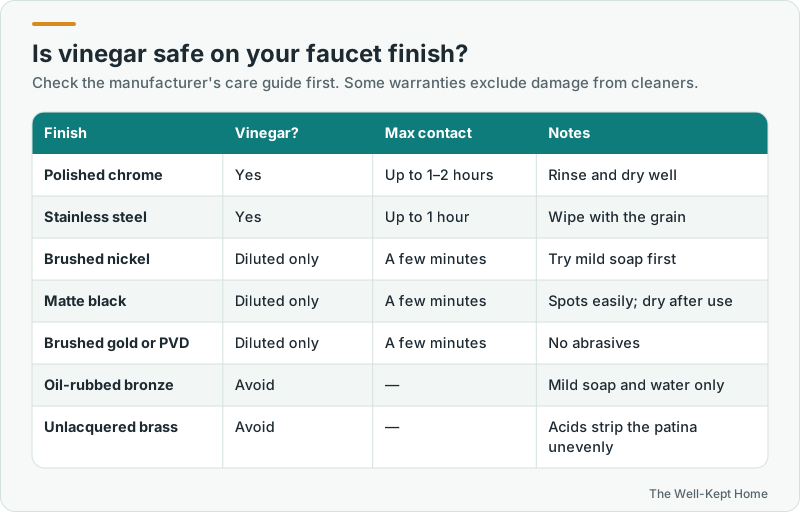
Care guides for specialty finishes almost always say the same thing: clean with mild soap and water, dry with a soft cloth, and avoid acidic, abrasive, or harsh chemical cleaners. If your faucet has one of those finishes, treat vinegar as a short, diluted, last-resort option, and read the care guide or warranty first. Some warranties exclude damage caused by cleaning products.
Chrome and stainless: the bag method
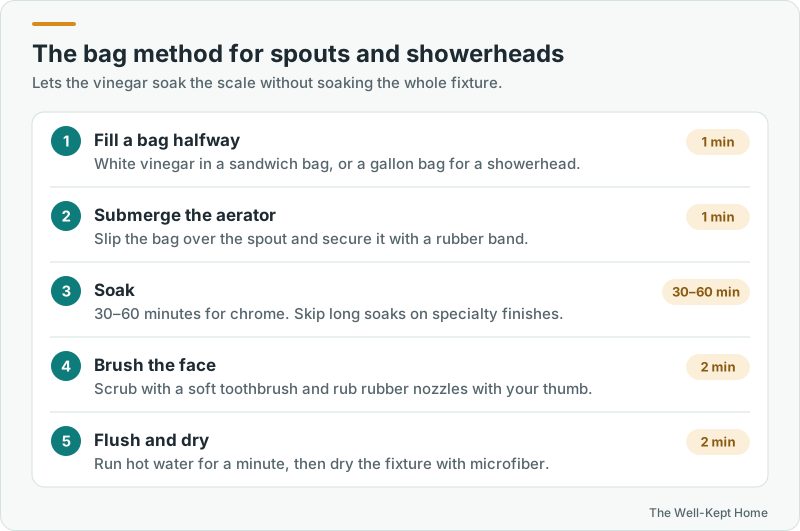
- Fill a small plastic sandwich bag about halfway with white vinegar.
- Slip it over the end of the spout so the aerator sits fully in the vinegar, and secure it with a rubber band or hair tie.
- Leave it for 30 to 60 minutes. Heavily crusted chrome can go a couple of hours. Avoid overnight soaks, which can leave dull spots even on chrome.
- Remove the bag and scrub the aerator face with a soft old toothbrush.
- Run hot water for a minute to flush out loosened scale, then dry the faucet with a microfiber cloth.
The base and handles
Soak a paper towel or microfiber cloth in vinegar and wrap it around the base of the faucet and the handles. Leave it 20 to 30 minutes, keeping it damp, then work the seam where the faucet meets the counter with a toothbrush. That seam is where scale and grime collect most. Rinse and dry.
If the aerator is badly clogged
Take it off. Most aerators unscrew by hand, or with pliers wrapped in a cloth so they don’t scratch. Some newer faucets use a hidden aerator that needs a small plastic key, which usually comes with the faucet. Lay the parts out in order as you remove them, because the screens go back in a specific sequence. Soak them in a cup of vinegar for an hour, brush them clean, rinse, and reassemble.
Specialty finishes: a gentler approach
For matte black, brushed nickel, brushed gold, oil-rubbed bronze, and similar finishes:
- Start with warm water and a few drops of dish soap on a soft cloth. Light scale often comes off with a little patience.
- If that fails and your manufacturer doesn’t prohibit it, mix vinegar with an equal amount of water, apply it with a cloth for no more than a few minutes, then rinse right away and dry.
- Never use abrasive pads, powdered cleansers, or calcium and lime removers on these finishes.
- Dry the faucet after use whenever you can. On matte finishes, water spots are the main enemy, and they’re far easier to prevent than to remove.
Unlacquered brass is a special case. It’s meant to darken and develop a patina over time. Acids remove that patina unevenly and leave blotches, so stick to mild soap and water. If you want it bright, polish the whole fixture with a brass polish rather than spot-cleaning it with vinegar.
Don’t forget the showerhead
Showerheads take the same treatment. Fill a gallon-size bag with vinegar, submerge the face, and tie the bag around the shower arm for 30 to 60 minutes. Many showerheads have flexible rubber nozzles; rubbing them with your thumb after the soak pushes out scale from inside. Run the shower for a minute afterward to flush the loosened bits.
Keep scale from building back up
- Wipe faucets dry after use, especially the base, where water pools.
- Soak the aerator every few months if you have hard water. It’s ten minutes of actual effort.
- Keep a microfiber cloth by the sink. Habits beat chemicals.
- If you’re descaling everything constantly, test your water. Very hard water affects much more than faucets, and a water softener may be worth pricing out.
Common questions
Will CLR or Lime-A-Way damage my faucet?
On chrome, used briefly and rinsed well, usually not. On brushed, matte, brass, and bronze finishes, many manufacturers warn against these products. Check the product label and the faucet’s care guide first.
Why does limescale come back so quickly?
Every drop of hard water that dries on the faucet leaves minerals behind. Wiping the faucet dry after use is the single best way to slow it down.
Can I use lemon juice instead of vinegar?
It works on light scale, since it contains citric acid, but it’s weaker and leaves a sticky residue. Rinse well afterward, and the same finish warnings apply.
The same minerals cause cloudy shower doors, and the same chemistry clears them. See our guide to removing hard water stains from glass shower doors.