New windows are one of the most visible home upgrades, and window companies often sell them as a way to slash energy bills. Efficient windows do reduce heat loss and gain, improve comfort, and cut outside noise. They’re also expensive, and as a pure energy investment they usually take much longer to pay back than air sealing or insulation. Here’s how to decide whether replacement makes sense, what the ratings mean, and what to expect to pay.
Table of Contents
When window replacement makes sense
- You have single-pane windows, especially in a cold or very hot climate.
- Double-pane units have failed seals, which show up as fogging or condensation between the panes.
- Frames are rotted, warped, or damaged.
- Windows won’t open, close, or lock properly.
- Drafts persist even after weatherstripping and caulking.
- You’re remodeling anyway, or you want better noise reduction.
ENERGY STAR estimates that replacing single-pane windows with ENERGY STAR certified windows lowers household energy bills by about 12% on average nationwide. Replacing existing double-pane windows that are in decent shape typically saves much less.
Cheaper fixes to try first
- Weatherstripping and caulking; see how to weatherstrip doors and windows
- Interior or exterior storm windows, which add an insulating layer for a fraction of the cost of replacement
- Cellular shades or insulated curtains
- Low-E window film on sunny windows in hot climates
- Repairing sash cords, locks, and glazing on older wood windows
How to read window ratings
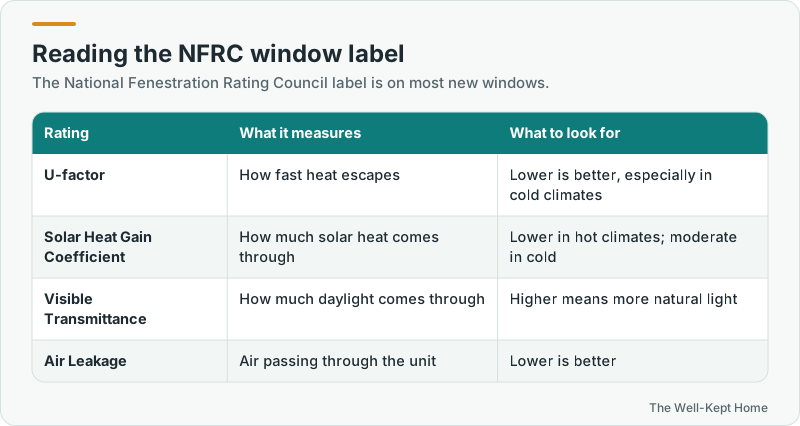
Most new windows carry a label from the National Fenestration Rating Council (NFRC):
- U-factor measures how quickly heat escapes through the window. Lower is better, and it matters most in cold climates.
- Solar Heat Gain Coefficient (SHGC) measures how much solar heat passes through. Lower values keep homes cooler in hot climates; in cold climates, a moderate SHGC can let in helpful winter sun.
- Visible Transmittance measures how much daylight comes through.
- Air Leakage, when listed, measures how much air passes through the window unit itself. Lower is better.
ENERGY STAR sets different requirements for different climate regions, so look for windows certified for your area.
Features that matter
- Double vs. triple pane. Double-pane low-E windows suit most U.S. climates. Triple-pane windows insulate better and are most worthwhile in very cold regions.
- Low-E coatings, microscopically thin layers that reflect heat.
- Gas fills such as argon between the panes, which slow heat transfer.
- Warm-edge spacers that reduce heat loss at the edge of the glass.
- Frame material. Vinyl, fiberglass, wood, and composite frames insulate well. Aluminum conducts heat unless it has a thermal break.
What replacement windows cost
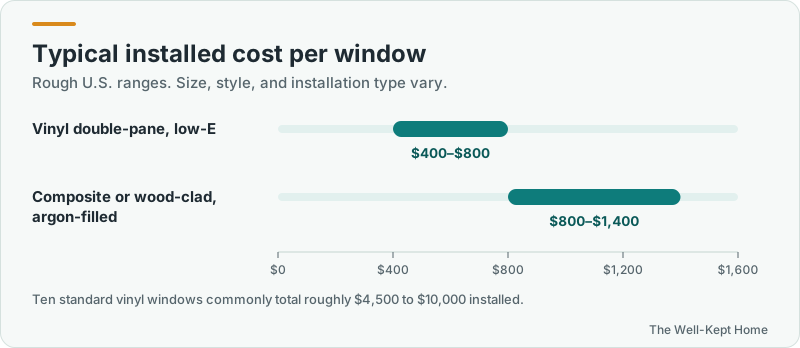
Cost guides commonly put a standard vinyl double-pane, low-E replacement window at roughly $400 to $800 installed, with averages around $575. Composite or wood-clad windows with gas fills commonly run about $800 to $1,400 each. A project of ten standard vinyl windows often totals roughly $4,500 to $10,000. Large, custom, or specialty shapes cost more.
Installation type also matters. An insert or pocket replacement fits a new window into the existing frame and costs less. Full-frame replacement removes the old frame entirely and is needed when the frame is rotted or damaged. It also gives the installer a chance to air seal and insulate around the opening properly.
Note that the federal tax credit that used to cover part of the cost of efficient windows ended for projects completed after 2025. Some utilities and states still offer incentives; see energy efficiency rebates for homeowners.
Hiring an installer
- Installation quality matters as much as the window. Ask how they seal and insulate around the frame.
- Homes built before 1978 may have lead paint. Under EPA rules, contractors who disturb paint in these homes must be certified in lead-safe practices. Ask for proof.
- Read the warranties for both the window and the installation labor.
- Get at least three quotes for the same window specs.
- Be wary of high-pressure sales, such as “today only” discounts or long in-home presentations.
Common questions
How long do new windows take to pay back?
On energy savings alone, often decades, especially when replacing double-pane windows. Comfort, noise reduction, and fixing failing windows are usually the bigger reasons to replace.
Should I replace all windows at once?
Not necessarily. Prioritize failing windows and those on the coldest or sunniest sides of the house. Replacing several at once usually lowers the per-window cost.
What should I do before replacing windows?
Consider an energy audit, which may show that air sealing and attic insulation will save more for less money. See home energy audits.