Anyone who has lived through a renovation knows the dust doesn’t stay in the work zone. Drywall dust, sawdust, and grout haze drift into every room, settle on every horizontal surface, coat the inside of cabinets, and work their way into the HVAC system. Regular house cleaners usually aren’t equipped for it, and a standard vacuum can choke on fine drywall dust. Post-construction cleaning is a specialized service designed for exactly this mess.
Table of Contents
What post-construction cleaning involves
Construction cleaning is more than a heavy deep clean. It typically includes:
- Removing construction debris, scraps, packaging, and labels
- HEPA vacuuming of floors, walls, ceilings, vents, and inside cabinets and drawers to capture fine dust
- Wiping every surface, often more than once, since dust keeps settling
- Cleaning windows, tracks, and sills, and removing stickers and paint specks from glass
- Removing grout haze from new tile and adhesive residue from fixtures
- Cleaning new appliances, fixtures, and light fittings
- Detailed cleaning of floors, appropriate to the new flooring material
The three phases
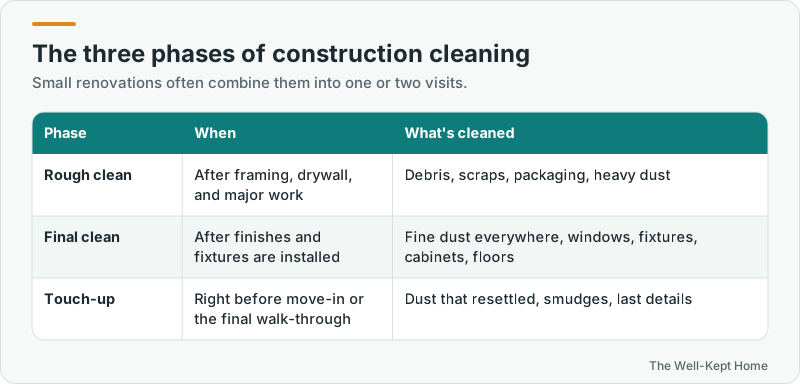
Commercial construction projects often schedule three separate cleans. For home renovations, the phases are often combined, but it helps to understand them:
- Rough clean: after framing, drywall, and the heaviest work, to clear debris and bulk dust so finish work can proceed.
- Final clean: after fixtures, cabinets, and finishes are installed. This is the most detailed phase and the one most homeowners book.
- Touch-up clean: just before move-in or the final walk-through, to catch dust that resettled and smudges from last-minute fixes.
What it costs
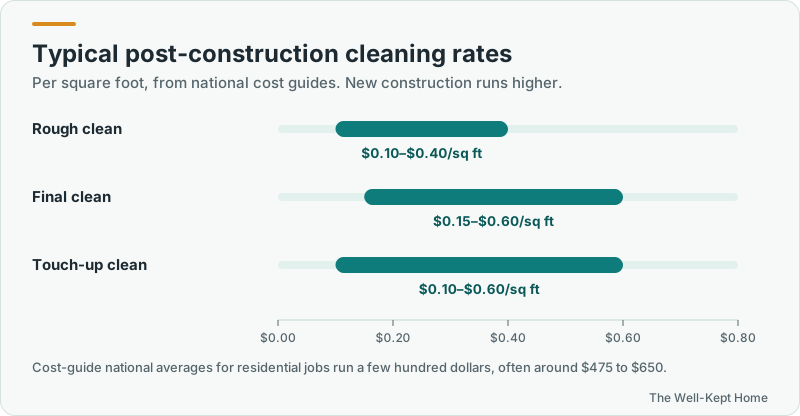
Post-construction cleaning is often priced per square foot. Cost guides commonly put rough cleans at roughly $0.10 to $0.40 per square foot, final cleans at about $0.15 to $0.60, and touch-ups in a similar band, with new construction toward the higher end. National averages for residential jobs commonly run a few hundred dollars, often around $475 to $650, though large or very dusty projects cost more. Get a quote after the cleaner sees the space, since the amount of dust and debris varies enormously.
Timing with your contractor
- Clarify what your contractor’s cleanup includes. Many contracts include “broom clean,” which means debris removed and floors swept, not a detailed clean.
- Book the final clean after all trades are finished. If the electrician comes back to install fixtures after the clean, dust returns.
- Leave a day or two between the final clean and move-in for a touch-up if needed.
Don’t forget the HVAC system
Renovation dust gets pulled into the return vents. Ideally, returns were covered and the system was off during dusty work. Either way, change the HVAC filter right after construction, and check it again a few weeks later; see how often to change your HVAC filter. After a major renovation where heavy dust got into the ducts, duct cleaning can be worthwhile; see whether air duct cleaning is worth it.
Choosing a post-construction cleaning company
- Ask about construction experience. It’s a different job from house cleaning, with different tools.
- Confirm HEPA equipment. Regular vacuums spread fine dust and can be damaged by it.
- Ask how they protect new finishes, such as hardwood, stone, and new fixtures, and what products they use.
- Get the scope in writing: rooms, inside cabinets, windows, and debris removal.
- Check insurance, since sharp debris and ladders add risk.
Safety around construction debris
Construction leaves hazards behind: screws and nails, sharp metal scraps, broken glass, and fine silica dust from cutting tile or concrete. Professional crews wear gloves and respirators and know how to handle debris safely. If you’re doing it yourself, wear sturdy shoes, gloves, eye protection, and a properly fitted N95 or better mask whenever dust is in the air.
Doing it yourself
For a small project, you can do it yourself with a HEPA shop vacuum, plenty of microfiber cloths, and patience. Work top to bottom: ceilings, light fixtures, walls, cabinets, counters, then floors. Expect dust to keep appearing for a week or two as it settles out of the air; a second wipe-down is normal. Wear a dust mask, since fine drywall dust irritates the lungs.
Common questions
How soon after construction can cleaning start?
After the last trade finishes dusty work. Paint should be fully dry, and adhesives and grout should have cured as the installer recommends.
Why is there still dust after the cleaners left?
Fine dust stays airborne and settles over days. A touch-up clean a few days later, and a fresh HVAC filter, solve most of it.
Will my homeowners insurance cover it?
Generally not for planned renovations. If the cleaning follows an insured loss, such as fire or water damage repairs, it may be part of the claim.
Can regular house cleaners do it?
Some can for light renovation dust. For heavy dust and debris, a company with construction cleaning experience and HEPA equipment is a better choice.