Most fruit fly problems don’t need an exterminator. Throw out the overripe produce, clean the drains and recycling, set a few vinegar traps, and the flies are usually gone within two weeks. But some infestations refuse to quit, and that almost always means the flies are breeding somewhere you haven’t found. That’s when professional pest control earns its fee.
Here’s when to call, what a pro actually does, and what it typically costs.
Table of Contents
When a professional makes sense
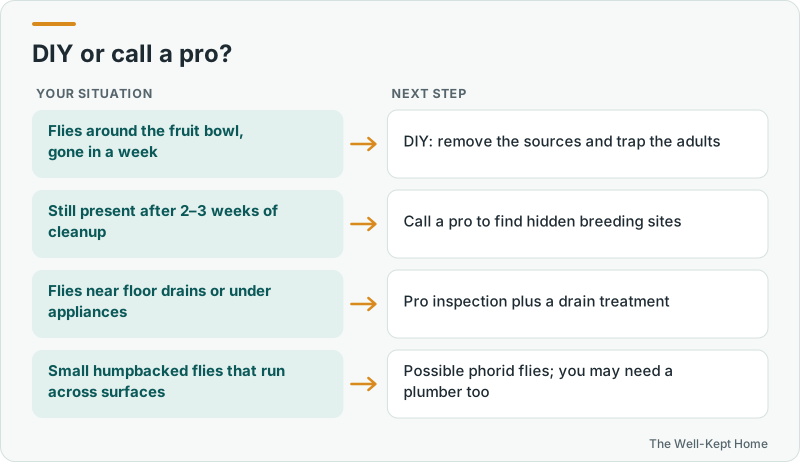
- You’ve removed obvious sources, cleaned drains, and trapped for two to three weeks, and the flies are still there.
- Flies are showing up in several rooms, not just the kitchen.
- You see flies coming from floor drains, under appliances, or from behind cabinets.
- You run a home business that handles food, or the problem is in a rental unit with shared plumbing.
- The flies don’t look quite like fruit flies, which may mean a different species with a different source.
If you haven’t done the basic cleanup yet, start with our guide on getting rid of fruit flies in the kitchen. A technician will ask about it anyway.
What a pest control visit involves
Inspection and identification
A good technician starts by confirming what you have. Fruit flies, drain flies, fungus gnats, and phorid flies look similar to most people but breed in very different places. Phorid flies, sometimes called humpbacked flies, tend to run across surfaces rather than fly away, and they can indicate decaying organic matter in hard-to-reach spots, including a broken sewer line under a slab. That’s a plumbing repair, not just a pest treatment.
Finding the breeding site
The technician checks drains, garbage disposals, floor drains, under and behind appliances, under the kick plates of cabinets, the recycling area, pantry storage, and any spots with leaks or standing water. This is the part that solves the problem.
Treatment
- Sanitation recommendations specific to what they found.
- Drain treatments with bio-based foams or gels that break down the organic film flies breed in.
- Monitoring and traps to catch adults and track progress.
- Targeted insecticide use in some cases, mainly to knock down a large adult population. Spraying alone doesn’t fix fruit flies, because it doesn’t touch the breeding source.
Follow-up
Persistent infestations often need a second visit to confirm the source is gone and adjust the plan.
How much does it cost?
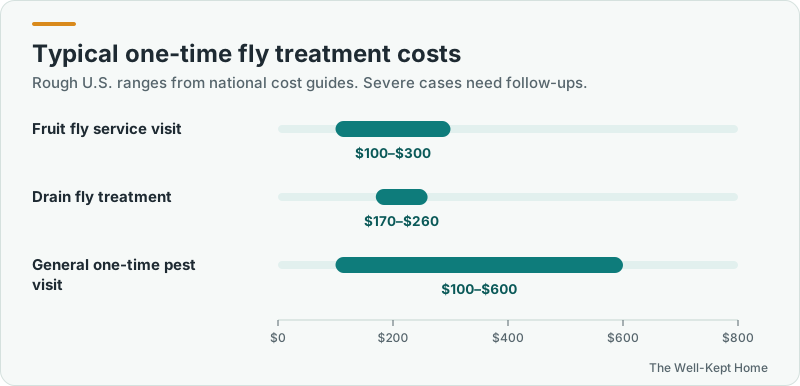
Cost guides put a one-time professional visit for fruit flies at roughly $100 to $300, and drain fly treatments in a similar range, often around $170 to $260. A general one-time pest visit can run anywhere from about $100 to $600 depending on the home’s size, the severity of the problem, and the number of follow-ups. If the source turns out to be a plumbing problem, the plumbing repair is a separate cost. These figures come from national cost guides and vary by region, so treat them as rough.
For a fruit fly problem alone, you usually don’t need a quarterly service plan. A one-time visit with a follow-up is typically enough once the source is fixed.
How to choose a company
- Licensing and insurance. Pest control applicators are licensed at the state level in the U.S. Ask for the license number.
- An integrated pest management approach. Good companies focus on finding and removing the source, using chemicals only where they help.
- Species identification. Ask what fly they think it is and why.
- Clear product information. Ask what they’ll use, where, and whether kids and pets need to stay out of treated areas, and for how long.
- A retreatment policy. Find out whether follow-up visits are included if the flies come back.
- No long contracts for a one-time problem.
How to prepare for the visit
- Leave a trap or two in place so the technician can see what you’re catching.
- Write down where and when you see the most flies.
- Clear access to the sink cabinets, floor drains, and the area around the fridge and dishwasher.
- Mention any recent leaks, plumbing work, or sewer smells.
Common questions
Will the exterminator just spray?
A good one won’t rely on spray. Fruit flies are a sanitation and breeding-site problem, so inspection, drain treatment, and source removal do the real work.
Are the treatments safe for pets?
Most fly treatments are targeted and low-volume, but ask what products will be used and follow any re-entry instructions, especially for birds and fish, which are more sensitive.
How fast will the flies disappear?
Once the breeding source is removed, the remaining adults usually die off within one to two weeks.