Finding a green cleaning service near you is easy; finding one that actually delivers on its claims takes a little more work. Plenty of local companies now advertise eco-friendly or non-toxic cleaning, but what they mean by it varies widely. Here’s how to find genuine green cleaners in your area, what to ask before you book, and how to set up visits so they match your household’s needs.
Table of Contents
Who should look for a green cleaning service
- People with asthma or allergies, who can react to strong fumes, fragrances, and fine dust.
- Anyone sensitive to fragrance, including people who get headaches from scented products.
- Families with babies or toddlers, who crawl on floors and put hands in their mouths.
- Pet owners, since pets walk on and lick freshly cleaned floors.
- Anyone who wants less plastic waste and fewer harsh chemicals at home.
How to find green cleaners near you
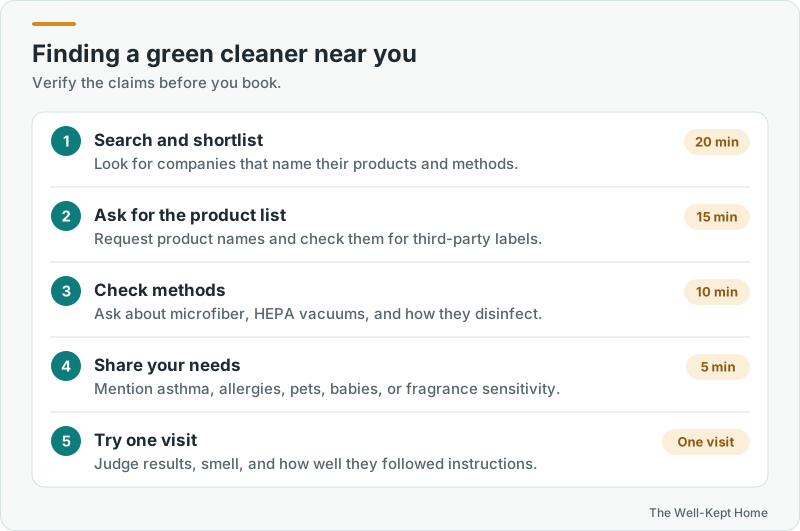
- Search and shortlist. Look for local companies that name their products and describe their methods on their websites, rather than just using green language.
- Ask for the product list. A genuine green cleaner will tell you exactly what they use. Look the products up for third-party certifications such as EPA Safer Choice, Green Seal, or UL ECOLOGO.
- Check their methods. Microfiber cloths and mops and HEPA-filter vacuums are signs of a company that has thought about how it cleans, not just what it cleans with.
- Share your needs. Tell them about asthma, allergies, pets, babies, or fragrance sensitivity, and ask how they’d adapt.
- Try one visit. Judge the results, the smell afterward, and how well they followed your instructions.
Questions to ask
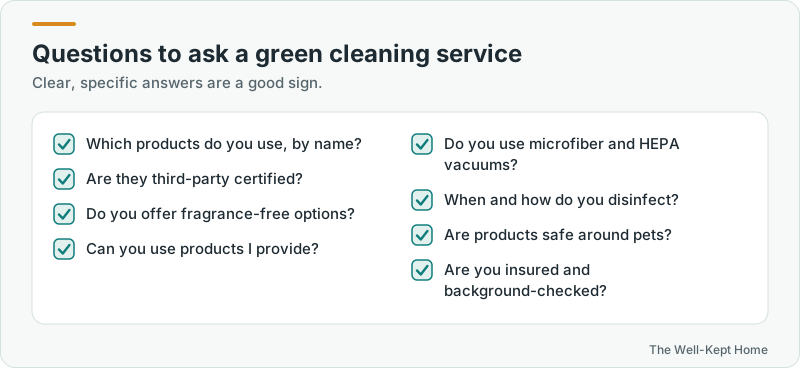
- Which products do you use, by name, and are they third-party certified?
- Do you offer fragrance-free options?
- Can you use products I provide if I prefer?
- Do you use microfiber and HEPA-filter vacuums?
- When do you disinfect, and with what?
- Are your products safe around pets once dry?
- Can you share safety data sheets for your products?
- Are you insured, and are your cleaners background-checked?
Clear, specific answers are a good sign. Vague responses, such as “everything we use is natural,” are not. Our guide to what eco-friendly cleaning should mean explains how to spot greenwashing.
Using your own products
If you have specific products you trust, many cleaners will use them. Keep them together in a labeled caddy, include microfiber cloths, and make sure there’s enough for each visit. Ask whether supplying your own products changes the price; some companies offer a small discount, others don’t.
Setting up the service
- Put your preferences in writing: fragrance-free, no bleach, no aerosols, pet-safe products, or whatever applies.
- List any surfaces that need special care, such as natural stone counters, which shouldn’t be cleaned with vinegar. See whether vinegar is safe on granite.
- Agree on disinfection: which areas, how often, and with what.
- Ask about ventilation: cleaners can open windows or run fans while they work.
- Give feedback early. If a product leaves a smell or residue that bothers you, say so after the first visit.
What to expect from the results
A good green clean should leave your home looking just as clean as a conventional one, with less lingering scent. Very heavy buildup, such as years of soap scum or a neglected oven, may take a little longer with gentler products, or need a dedicated deep clean first. See deep cleaning services.
What it costs
Green cleaning is often priced similarly to conventional cleaning, sometimes slightly higher. Use the same comparison approach you’d use for any cleaner: compare checklists, hours, and team size. See house cleaning prices for typical ranges.
Keeping it green between visits
You can keep the same approach going yourself. A vinegar spray handles glass and mineral film, dish soap and water handle most counters, and baking soda handles scrubbing and odors. See DIY all-purpose cleaner with vinegar and how to clean with baking soda and vinegar.
Common questions
Is green cleaning safe for people with asthma?
Fragrance-free, certified products and HEPA vacuums generally reduce common triggers. Everyone reacts differently, so tell the company about specific sensitivities and try one visit first.
Do green cleaners clean as well as regular cleaners?
A skilled green cleaner gets comparable results. Technique and equipment matter more than the strength of the product.
How can I verify a company’s green claims?
Ask for product names and look up their certifications. Third-party labels from recognized certifiers carry more weight than a company’s own claims.
Can a green service handle mold?
Cleaners can wipe small amounts of surface mildew, but larger mold problems need a specialist. See mold remediation.