Most single clogs are DIY jobs: pull the stopper, plunge, clean the trap, or run a hand auger. But some drain problems are beyond what household tools can reach, and some are warnings about the main line that connects your home to the sewer or septic system. That’s when a professional drain cleaning service is worth calling.
Here’s how to tell when you need one, what the main services are, and how to choose a company.
Table of Contents
Signs you need a professional
- Several drains are slow at the same time. One slow sink is a local clog. Three slow fixtures usually point to a shared line.
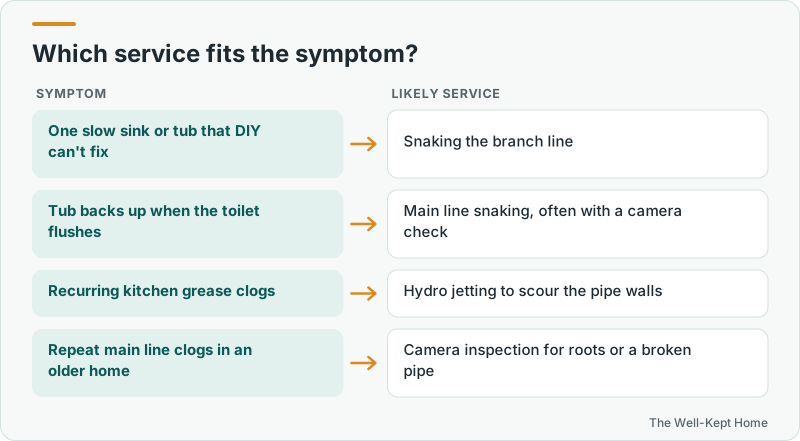
- Water backs up in the tub or shower when you flush the toilet or run the washing machine. This is a classic main line symptom.
- Gurgling toilets and drains, especially when another fixture drains.
- Sewage smell or water coming up through a basement floor drain.
- Clogs that keep coming back a few weeks after you clear them.
- An older home with trees nearby, where roots can work their way into clay or cast iron sewer pipes.
- Your 25-foot hand auger can’t reach the clog.
The main drain cleaning services
Snaking (augering)
Plumbers use motorized drain machines with cables sized to the pipe. Smaller machines handle sink and tub branch lines. Larger ones with 75 to 100 feet or more of heavy cable handle main sewer lines, usually through a cleanout, a capped access pipe outside or in the basement. Snaking punches through or retrieves the clog and is the most common, least expensive professional service.
Hydro jetting
Hydro jetting sends highly pressurized water through the pipe with a specialized nozzle that scours the walls. It removes grease, scale, sludge, and small roots more completely than a cable, which tends to punch a hole through a clog. It’s especially useful for recurring kitchen grease clogs and main lines. It costs more than snaking, and it isn’t appropriate for pipes that are already cracked or collapsing, which is why many plumbers inspect with a camera first.
Camera inspection
A waterproof camera on a flexible cable shows the inside of the pipe on a screen. It reveals root intrusion, cracks, offset joints, sagging sections where water pools, and the exact location and depth of a problem. It’s the best way to decide whether a recurring clog needs cleaning, repair, or replacement.
What to expect at the visit
- The plumber asks about symptoms and which fixtures are affected.
- They locate the best access point, often a cleanout.
- They clear the line by snaking or jetting.
- They run water through several fixtures to confirm it’s flowing.
- For recurring or main line problems, they may recommend a camera inspection.
Prices vary by service and timing. Our breakdown of drain cleaning costs lists typical ranges.
How to choose a drain cleaning company
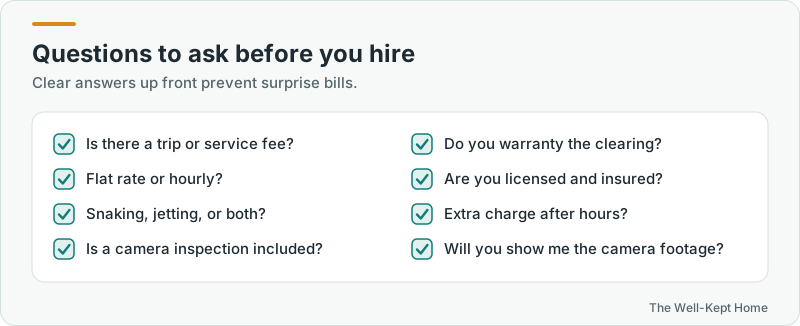
- Licensing and insurance. Plumbers are licensed by the state in most places. Ask for the license number.
- Upfront pricing. Ask about the trip or service fee, whether the price is flat or hourly, and any after-hours charges, before they start.
- A warranty on the clearing. Many companies guarantee a cleared line for 30 to 90 days.
- Camera before major recommendations. If someone recommends replacing a sewer line, ask to see the footage, and consider a second opinion. Replacement is expensive, and spot repairs or lining are sometimes options.
- Recent reviews that mention drain or sewer work specifically.
How to prepare
- Stop running water into the affected drains so you don’t cause an overflow.
- Know where your main cleanout is, if you can find it. It’s often a capped pipe near the foundation, in the basement, or in the yard.
- Clear access to the affected fixtures and the cleanout.
- Note what’s happening: which drains, since when, and any sounds or smells.
- Mention any chemical drain cleaners you’ve used, for the plumber’s safety.
Preventing the next call
- Keep grease, oil, and coffee grounds out of the kitchen sink.
- Flush only toilet paper. “Flushable” wipes are a common cause of main line clogs.
- Use hair catchers in showers and tubs.
- Use an enzyme drain cleaner monthly; see enzyme vs. chemical drain cleaners.
- If roots are a recurring problem, ask about scheduled maintenance cleaning or a permanent repair.
Common questions
How long does professional drain cleaning take?
A simple branch line clog often takes under an hour. Main line clearing, hydro jetting, or a camera inspection can take one to three hours.
Do I need hydro jetting or is snaking enough?
Snaking is enough for most single clogs. Hydro jetting makes sense for heavy grease, recurring clogs, and root intrusion, ideally after a camera check.
Is a sewer backup covered by homeowners insurance?
Often not by a standard policy. Coverage for sewer and drain backup is usually an optional endorsement, so check your policy before you need it.