Most kitchen ant problems can be handled with bait stations, cleanup, and sealing a few gaps. But some ants are different. Carpenter ants can damage wood, pharaoh ants multiply when you spray them, fire ants sting, and some infestations come back no matter how many bait stations you set out. That’s when it’s worth calling an ant exterminator.
Here’s what a professional ant treatment involves, what it typically costs, and how to choose a company.
Table of Contents
When to call a professional
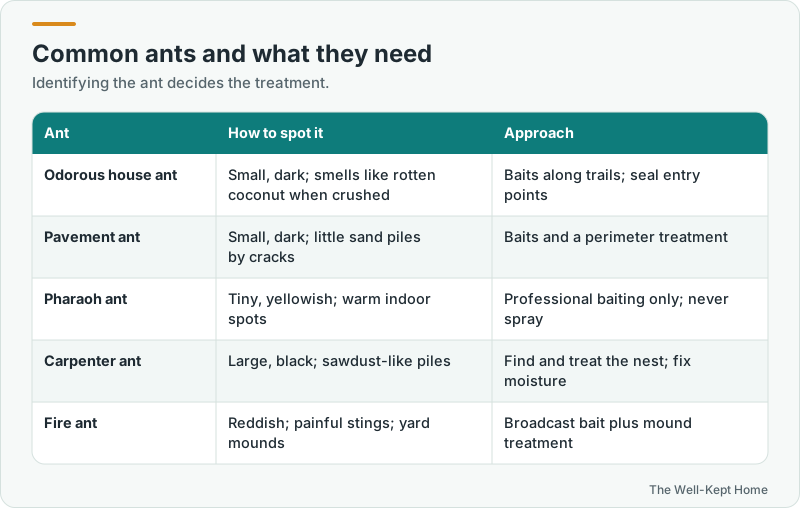
- Carpenter ants. Large black or red-and-black ants, small piles of sawdust-like debris, rustling sounds in walls, or winged ants indoors in spring. They nest in damp or damaged wood and can weaken it over time.
- Pharaoh ants. Tiny, pale yellowish ants that nest in warm, hidden spots. Spraying can cause their colonies to split, so they need careful baiting.
- Fire ants. Reddish ants with painful stings, and mounds in the yard.
- Ants that keep coming back after several weeks of baiting and cleanup.
- Multiple colonies or ants in several rooms.
If you’re dealing with ordinary sugar ants in the kitchen, try our guide on getting rid of ants naturally first.
What a professional treatment involves
Inspection and identification
A technician identifies the species, finds the trails, and looks for nests and entry points inside and out. The species decides the treatment, so this step matters.
Baiting
Professionals use gel and granular baits that workers carry back to the colony. Placed correctly and left alone, baits can eliminate a colony, including the queen.
Non-repellent perimeter treatments
Many pros use non-repellent insecticides around the foundation and entry points. Ants don’t detect them, so they walk through and carry the product back to the colony. Repellent sprays, by contrast, mostly kill or deflect the ants you see.
Direct nest treatment
For carpenter ants, technicians locate the nest and treat it directly, sometimes by drilling small holes into a wall void and applying an insecticide dust. They’ll also point out moisture problems, since carpenter ants favor wet or rotting wood.
Follow-up
Many ant treatments include a follow-up visit to check activity and re-bait if needed.
How much does an ant exterminator cost?
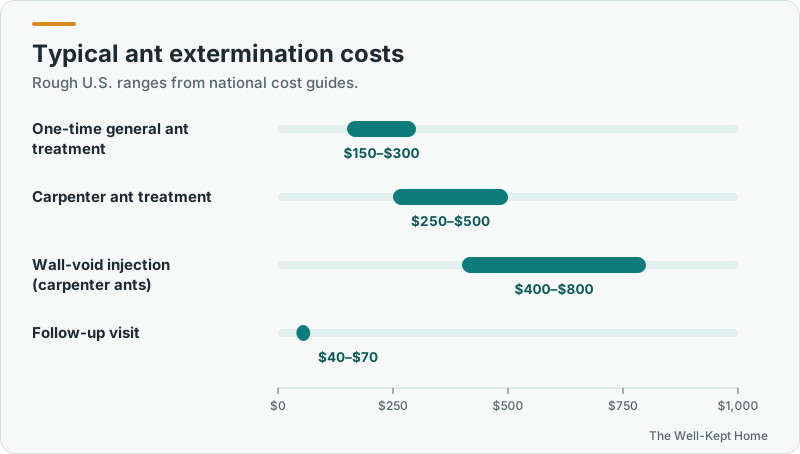
National cost guides put a one-time general ant treatment at roughly $150 to $300 for a typical home. Carpenter ant treatment usually costs more, commonly around $250 to $500, and jobs that involve wall-void injections can run $400 to $800 or more. Follow-up visits for severe infestations are sometimes charged separately, around $40 to $70 each. Fire ant yard treatments and ongoing quarterly pest plans are priced differently, so ask for a written quote. These figures are rough national ranges and vary by region and home size.
How to choose an ant exterminator
- Licensed and insured. Pest control applicators are licensed by the state. Ask for the license number.
- Identifies the ant. A company that sprays without asking questions or identifying the species is guessing.
- Explains the products. Ask what will be used, where, and what precautions kids and pets need.
- Offers a retreatment guarantee. Find out what happens if ants return within a set period.
- Doesn’t push a long contract for a one-time problem. Quarterly plans make sense for some homes, especially in warm climates, but they shouldn’t be the only option offered.
- Gets compared. Two or three quotes help you spot an outlier.
How to prepare
- Don’t spray store-bought insecticides in the days before the visit. It scatters ants and makes baiting less effective.
- Note where and when you see the most ants, and take photos if you can.
- Clean up food and crumbs, but leave the trails visible.
- Plan to keep pets and children away from treated areas for the time the technician recommends.
Preventing a repeat visit
- Seal gaps around windows, doors, and pipes.
- Keep firewood, mulch, and plants away from the foundation.
- Fix leaks and moisture problems, especially for carpenter ants.
- Store food in sealed containers and keep counters clean.
Common questions
How long does ant treatment take to work?
Baits usually reduce activity within a few days and can eliminate a colony within one to two weeks. Carpenter ants and large infestations may take longer and need a follow-up.
Is ant treatment safe for pets?
Most professional ant products are applied in small amounts in targeted spots. Ask about the specific products and follow the re-entry instructions.
Do I need a quarterly pest control plan?
Not necessarily. For a single ant problem, a one-time treatment with a follow-up is often enough. Quarterly plans can make sense in warm climates with constant pest pressure.