The stopper in your bathroom sink is a hair magnet. Every time you brush your teeth, shave, or wash your face, a little hair, soap, and toothpaste washes down and catches on it. Over time that buildup slows the drain, starts to smell, and eventually forms a clog. Pulling the stopper out and cleaning it takes about 10 minutes, and it’s often all a slow sink needs.
The trick is knowing which kind of stopper you have, because each one comes out differently.
Table of Contents
Identify your stopper
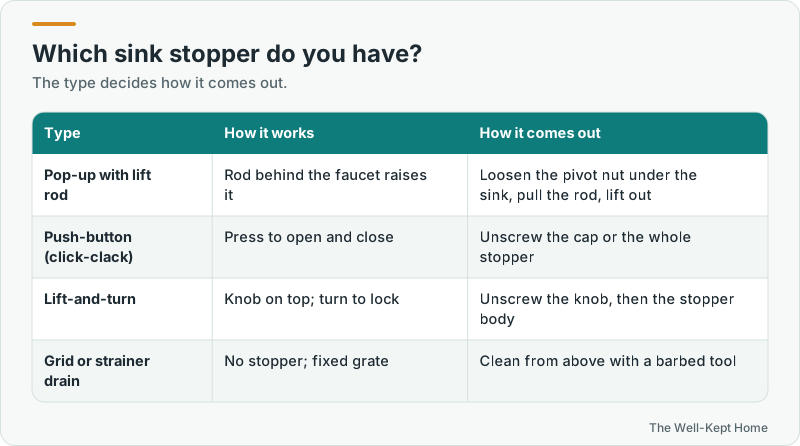
- Pop-up stopper with a lift rod. The most common type in U.S. bathrooms. You raise and lower it with a rod behind the faucet. Underneath the sink, a horizontal pivot rod connects to the drain pipe.
- Push-button stopper, also called a click-clack or press-and-seal stopper. You press it down to close and press again to open.
- Lift-and-turn stopper. It has a small knob on top. You lift and turn it to open or close.
- Grid or strainer drain. There’s no movable stopper, just a fixed grate. You clean these from above with a barbed drain tool.
How to remove a pop-up stopper
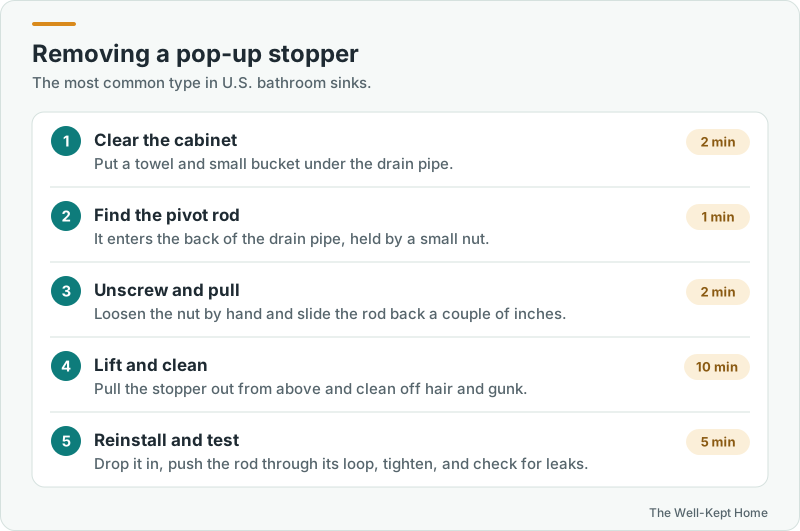
First, try lifting it out. Raise the stopper all the way and pull up while turning it slightly. Some pop-up stoppers come straight out. If yours doesn’t, it’s held in place by the pivot rod.
- Clear out the cabinet under the sink and put down a towel and a small bucket.
- Find the pivot rod. It’s the horizontal rod sticking out of the back of the drain pipe, connected to a metal strap that runs up to the lift rod.
- Unscrew the retaining nut where the pivot rod enters the drain pipe. It usually turns by hand. A few drops of water may come out.
- Pull the pivot rod back an inch or two, enough to free the stopper. You don’t need to disconnect it from the strap.
- Lift the stopper out from above.
Putting it back
Drop the stopper into the drain. Most stoppers have a hole or loop at the bottom of the stem; it needs to face the back, toward the pivot rod. Push the pivot rod back in so it passes through that hole, then tighten the retaining nut by hand. Test the lift rod. If the stopper doesn’t seal or open fully, adjust where the pivot rod attaches to the metal strap; the strap has several holes for that purpose. Run water and check the nut for drips. If it leaks, tighten it a little more.
How to remove a push-button stopper
- Press the stopper so it’s in the open, raised position.
- Grip the cap and turn it counterclockwise. On many models, the whole stopper unscrews from a threaded post inside the drain. On others, just the cap comes off and you then unscrew the body.
- If it’s stiff, use a rubber jar opener or a rag for grip. Avoid metal pliers, which scratch the finish.
- Clean the stopper and the threads, then screw it back in by hand.
How to remove a lift-and-turn stopper
- Open the stopper.
- Hold the body steady and unscrew the small knob on top.
- Unscrew the stopper body counterclockwise from the crossbar in the drain.
- Clean it, then screw it back in and replace the knob.
How to clean it
- Wear gloves. Pull off the hair and slime and drop it in the trash, not back down the drain.
- Soak the stopper in hot water with dish soap, or a mix of vinegar and water, for 10 minutes.
- Scrub it with an old toothbrush, especially the stem and the underside of the cap.
- While the stopper is out, push a barbed drain tool into the drain to pull out hair below it.
- Flush the drain with hot water for a minute before reinstalling the stopper.
If the sink is still slow afterward, the clog is farther down, usually in the P-trap. Our guide to unclogging a bathroom sink without chemicals covers the next steps.
How often to do it
Pulling and rinsing the stopper once a month prevents most slow drains. If several people share the sink, or someone has long hair, every two weeks is better. It’s an easy task to add to your regular bathroom cleaning routine.
Common questions
Why does my sink smell even after I clean the stopper?
Check the overflow hole near the top of the basin. Gunk builds up in that channel too. Clean it with a bottle brush and a little baking soda and vinegar. See how to get rid of smelly drains for other causes.
My pop-up stopper won’t stay up. How do I fix it?
The retaining nut on the pivot rod controls tension. Tighten it slightly so the rod holds its position. If that doesn’t work, the spring washer inside may be worn and need replacing.
Can I replace the stopper with a different type?
Yes. Replacement drain assemblies are sold at hardware stores. Swapping one involves removing the drain flange and installing a new one with plumber’s putty or a gasket, a manageable DIY job if you’re comfortable under the sink.