When you move out of a rental, your security deposit often depends on how clean the place is when you leave. Landlords and property managers look at details a normal weekly cleaning never touches: the inside of the oven, the shelves in the fridge, the tracks of the windows, and the dust on top of the door frames. A move-out cleaning service is designed around exactly those details.
Here’s what a move-out clean covers, when to schedule it, and how to protect your deposit.
Table of Contents
Why move-out cleaning matters
In most states, landlords can deduct from a security deposit for cleaning needed to return a unit to the condition it was in at move-in, minus normal wear and tear. What counts as normal wear and tear and how deductions must be itemized vary by state, so read your lease and your state’s tenant rules. Practically, though, a professionally cleaned unit with photos to prove it puts you in a strong position.
What landlords look for
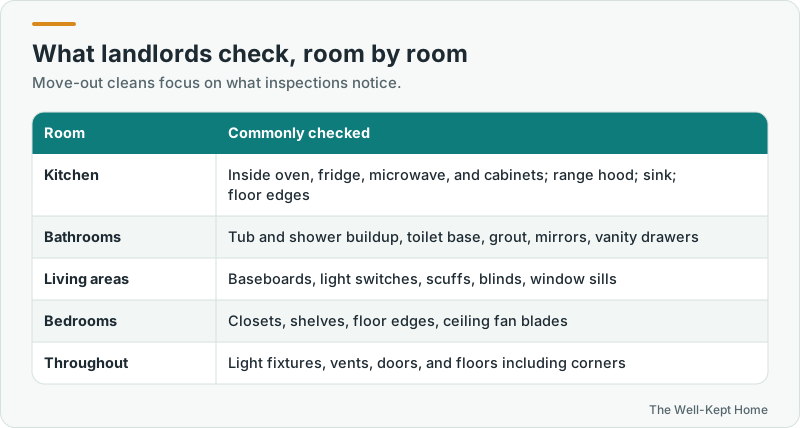
- Kitchen: inside the oven, refrigerator, freezer, microwave, and dishwasher; inside cabinets and drawers; the range hood and filter; the sink and faucet; and floor edges where crumbs collect.
- Bathrooms: soap scum and hard water buildup in the tub or shower, the toilet base and behind the toilet, grout, mirrors, and vanity drawers.
- Living areas and bedrooms: baseboards, light switches, door frames, blinds, window sills and tracks, closet shelves, and ceiling fan blades.
- Throughout: light fixtures, vent covers, scuffs on walls, and floors including corners.
What a move-out cleaning service includes
Because the home is empty, a move-out clean typically includes everything in a deep clean plus the inside of cabinets, closets, drawers, and appliances. Many companies list wall spot-cleaning and interior windows as options. Ask for the checklist and compare it with your lease’s move-out requirements.
It usually doesn’t include carpet shampooing, wall painting, repairs, or trash removal, though some companies offer these or can refer you. If your lease requires professional carpet cleaning, book it separately and keep the receipt.
Timing your move-out clean
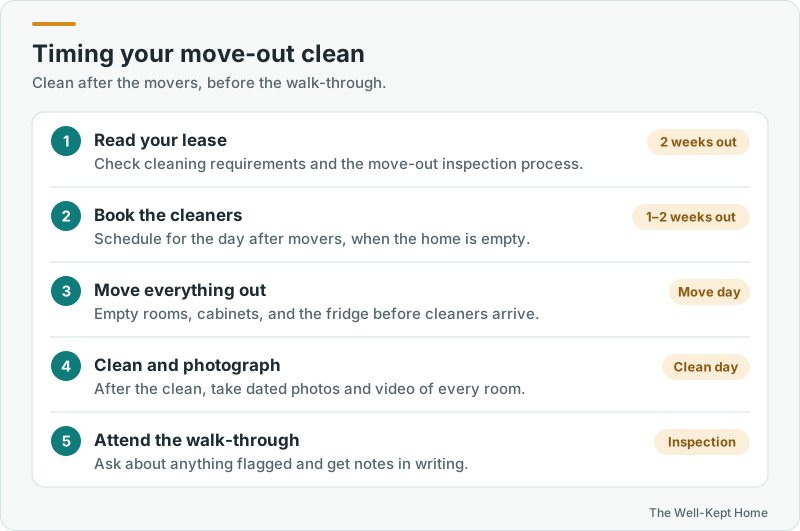
- Read your lease two weeks out. Note any cleaning requirements and how the move-out inspection works.
- Book the cleaners one to two weeks ahead. End-of-month dates fill up quickly.
- Schedule the clean after the movers. Cleaners need an empty home to reach cabinets, closets, and floor edges, and moving day tracks in dirt.
- Empty everything, including the fridge, cabinets, closets, and storage areas, before the cleaners arrive.
- Photograph the results. Take dated photos and a video of every room, including inside appliances and cabinets.
- Attend the walk-through if possible, and ask for any issues to be noted in writing.
What it costs
Move-out cleaning is priced by home size, condition, and add-ons. Cost guides commonly put apartment move-out cleans roughly in the low-to-mid hundreds of dollars, with larger homes and heavy buildup costing more. See move-out cleaning cost for typical ranges. Compare that with what a landlord might deduct for cleaning; professional cleaning is often the cheaper option.
Choosing a move-out cleaning company
- Ask whether they guarantee results or offer a free re-clean if the landlord flags something within a set time.
- Ask what’s included by default and what costs extra, such as inside the oven, fridge, and windows.
- Check insurance and recent reviews mentioning move-out or deposit-related cleans.
- Get the price in writing based on your home’s size and condition.
Common cleaning-related deductions
- A dirty oven, refrigerator, or microwave
- Soap scum and hard water buildup in showers and tubs
- Grease on the range hood and cabinet fronts
- Dust on blinds, baseboards, and ceiling fans
- Trash or belongings left behind
These are exactly the areas a professional move-out clean focuses on, which is why it often costs less than the deductions it prevents.
If you’re doing it yourself
Work top to bottom, room by room, and save floors for last. Start the oven and fridge early, since they take the longest. Our guides to cleaning an oven without harsh chemicals and removing soap scum from shower tiles cover the toughest jobs.
Common questions
Is professional move-out cleaning required?
Usually not, unless your lease says so. What’s required is a unit clean enough to meet the lease standard. Professional cleaning is simply the most reliable way to get there.
Can my landlord charge me for cleaning if I cleaned it myself?
Possibly, if the unit didn’t meet the standard required by the lease and state law. Photos taken right after cleaning are your best evidence.
How long does a move-out clean take?
A small apartment may take a few hours; a larger home with heavy buildup can take a full day with a team.
Should I be there?
It helps to be there at the end to check the work and take photos, especially inside appliances and cabinets.