A professional home energy audit usually costs a few hundred dollars, and in many areas it costs much less because utilities subsidize it. National cost guides commonly put a comprehensive audit, with a blower door test, an infrared scan, and a bill analysis, at roughly $200 to $700. A blower door test on its own typically runs about $150 to $450. Here’s what drives the price, what each level of audit includes, and how to decide whether it’s worth the money.
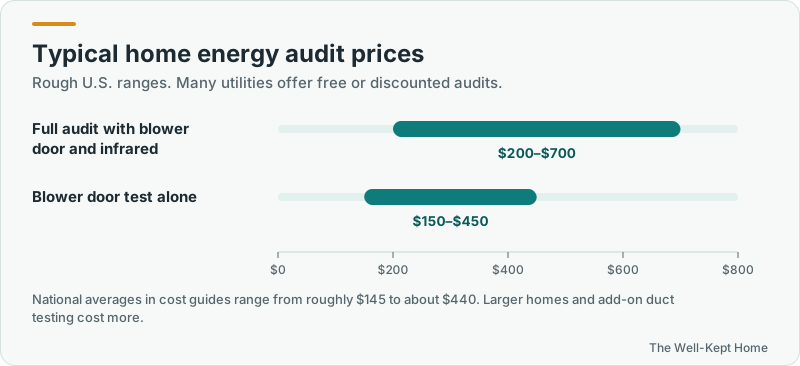
Table of Contents
What affects the cost
- Type of audit. A visual walk-through costs less than a comprehensive audit with diagnostic testing.
- Size of the home. Larger homes take longer to inspect and test.
- Add-on tests. Duct leakage testing, which uses a separate fan to pressurize the duct system, adds time and cost.
- Region. Prices tend to be higher in large metro areas.
- Report detail. Some auditors provide modeled savings estimates and detailed upgrade plans, which take more time to prepare.
Audit levels compared
Walk-through audit
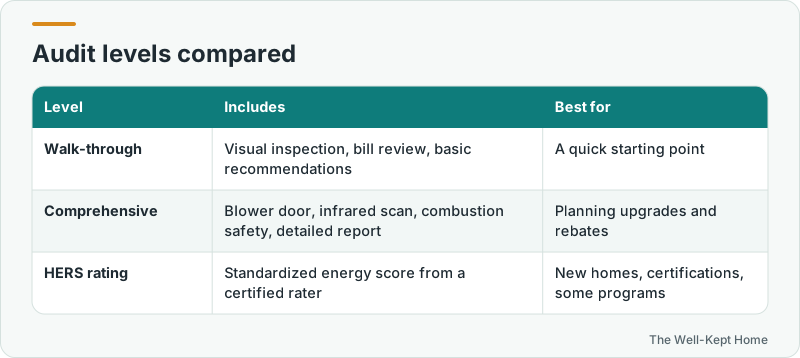
An auditor visually inspects the home, reviews your bills, and gives general recommendations. It’s useful as a starting point, and it’s what many free utility audits offer. It can miss hidden air leaks and insulation gaps.
Comprehensive audit
This adds a blower door test to measure air leakage, an infrared scan to find leaks and insulation gaps, combustion safety testing for gas appliances, and a detailed report. It’s the right choice if you’re planning significant upgrades or applying for rebates that require testing.
HERS rating
A Home Energy Rating System score, produced by a certified RESNET rater, rates a home’s efficiency on a standardized scale. It’s most common for new construction and green certifications, and some programs require one.
Free and discounted audits
Before paying full price, check:
- Your electric and gas utilities. Many offer free or low-cost audits, sometimes with free LED bulbs, showerheads, or smart power strips installed during the visit.
- Your state energy office, especially if your state runs whole-home rebate programs, which may include testing.
- Weatherization programs for income-qualified households, which include an assessment along with free upgrades.
One change to note: the federal tax credit that used to cover part of the cost of a home energy audit, part of the Energy Efficient Home Improvement Credit, ended for 2026 and later. See energy efficiency rebates for homeowners for what’s still available.
Is an energy audit worth the money?
Usually, yes, if you’re about to spend money on upgrades. The value of an audit isn’t the report; it’s avoiding the wrong project. Plenty of homeowners spend thousands on new windows when the real problem was an uninsulated attic hatch and leaky ductwork that would have cost a fraction as much to fix. An audit also flags safety issues, such as combustion appliances that vent poorly, which is worth knowing whether or not you upgrade anything.
An audit may be less valuable if your home is newer and performing well, if you don’t plan to make changes, or if you already know the problem, for example an attic you can see has only a few inches of insulation.
Getting the most from your audit
- Ask for a sample report before booking.
- Ask whether the auditor sells the upgrades they recommend, and get a second opinion for expensive items if so.
- Be home and walk through with the auditor.
- Ask for priorities ranked by cost-effectiveness, not just a list.
- Ask about a test-out after the upgrades to confirm the results.
Doing it yourself
A careful homeowner can find many problems with a flashlight, an incense stick, and a tape measure. See how to find air leaks in your house. Some hardware stores and phone accessories offer affordable thermal cameras that work best on cold days. A DIY check won’t measure total air leakage the way a blower door does, but it can point you to obvious fixes for little or no cost.
Common questions
How long does an audit take?
Two to four hours for a comprehensive audit in a typical home, plus time afterward for the auditor to prepare the report.
Do I need an audit to get rebates?
Some programs require one, especially whole-home rebate programs that pay based on modeled or measured energy savings. Check the program’s rules before starting work.
What’s a blower door test number?
Auditors often report air leakage as air changes per hour at a standard test pressure (ACH50). Lower numbers mean a tighter house. Your auditor can explain how your home compares with others of its age and type. For finding a qualified auditor, see home energy audits near you.