If your home has drafty rooms, a bedroom that’s always too hot, or energy bills that seem high for its size, a professional home energy audit is the most reliable way to find out why. Instead of guessing whether you need new windows, more insulation, or a new furnace, an auditor measures how your house actually performs and gives you a prioritized list of fixes. The U.S. Department of Energy sometimes calls this a home energy assessment.
Here’s what happens during an audit, who does them, and how to find one near you.
Table of Contents
What happens during an energy audit
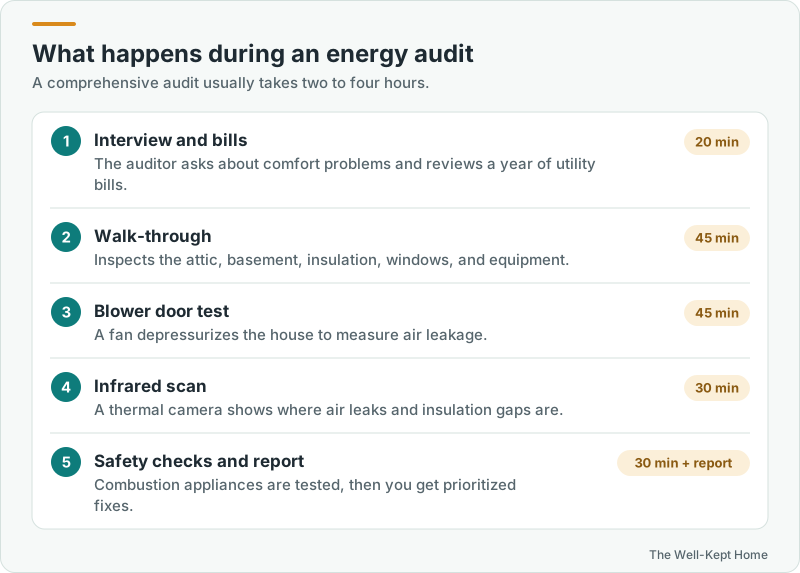
Interview and bill review
The auditor starts by asking about comfort problems, such as cold rooms, drafts, condensation, and ice dams, and reviewing about a year of utility bills. That shows how your usage changes with the seasons and where the biggest opportunities are likely to be.
Walk-through inspection
Next comes a room-by-room and top-to-bottom inspection: the attic and its insulation, the basement or crawlspace, the windows and doors, the heating and cooling equipment, the water heater, the ducts, and lighting and appliances.
Blower door test
This is the heart of a comprehensive audit. The auditor mounts a powerful fan in an exterior doorway and uses it to pull air out of the house, which lowers the indoor air pressure. Outside air then rushes in through every crack and gap. Instruments measure how leaky the house is overall, and the auditor walks through the house to find where the air is coming in.
Infrared scan
While the blower door runs, a thermal camera shows temperature differences on walls, ceilings, and floors. Cold streaks reveal air leaks and missing or settled insulation that you’d never find by looking.
Combustion safety testing
If you have gas, oil, or propane appliances, a good auditor tests them for carbon monoxide and proper venting. This matters because sealing air leaks changes how a house breathes, and appliances that vent poorly in a tighter house can be a safety hazard.
The report
You’ll receive a report with findings and a prioritized list of improvements, often with estimated costs and savings. In most homes, air sealing and attic insulation come near the top of the list, ahead of expensive equipment replacements.
Who does energy audits
- Independent auditors who don’t sell the upgrades they recommend.
- Utility programs. Many utilities offer free or discounted audits through approved contractors.
- Insulation, HVAC, and home performance contractors who offer audits as part of a sales process. These can be useful, but compare their recommendations against an independent opinion for big-ticket items.
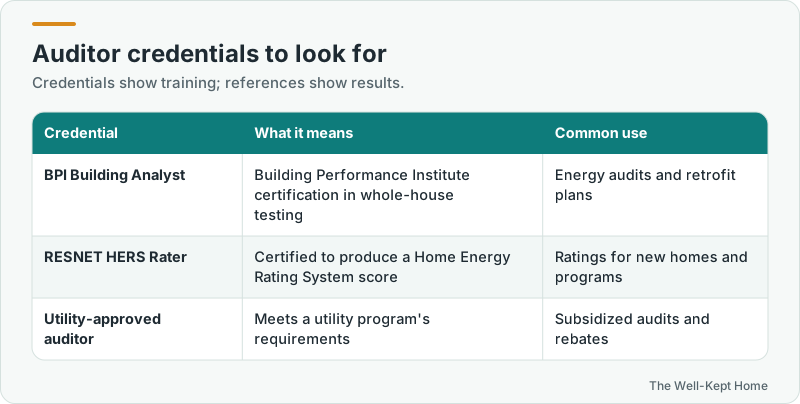
Look for credentials such as Building Performance Institute (BPI) certification or a RESNET Home Energy Rater credential, which show formal training in testing and analysis.
How to find an auditor near you
- Start with your electric or gas utility’s website. Search for “home energy audit” or “home energy assessment.”
- Check your state energy office, which often lists approved contractors for state programs and rebates.
- Search the BPI and RESNET online directories for certified professionals.
- Ask for sample reports before booking, so you know what you’ll receive.
How to prepare
- Gather 12 months of utility bills, or give the auditor access to your online account.
- Write down comfort problems and when they happen.
- Close all windows and exterior doors before the auditor arrives.
- If you have a fireplace or wood stove, make sure it’s cold and the ashes are cleaned out, since the blower door test can pull ash into the room.
- Clear access to the attic hatch, basement, crawlspace, furnace, and water heater.
- Plan to be home. Following the auditor around is one of the best ways to learn about your house.
What to do with the results
Tackle the recommendations in order. Air sealing usually comes first because it’s inexpensive and makes insulation work better; see how to find air leaks in your house. Then add attic insulation; see attic insulation installation. Check what rebates are available before you hire anyone; see energy efficiency rebates for homeowners. And ask the auditor about a test-out after the work, which confirms the improvements performed as expected.
Common questions
How long does an energy audit take?
A comprehensive audit with a blower door test typically takes two to four hours, depending on the size of the home.
Is a free utility audit worth it?
Yes. Even a basic audit can point you toward the most important fixes. Some free audits are walk-throughs without a blower door test, so ask what’s included.
Can I do my own energy audit?
You can find many problems yourself, such as obvious drafts, thin attic insulation, and leaky ducts. A professional blower door test and thermal scan find what you can’t see. See home energy audit costs to weigh the options.