“Maid service” usually means a cleaning company that sends a trained team on a schedule, often wearing uniforms, following a set checklist, and backed by company insurance. It’s one of two main ways to get regular help at home. The other is hiring an independent cleaner who works for themselves. Both can work beautifully, and both can disappoint. The difference is in how they handle cost, consistency, accountability, and flexibility.
Table of Contents
How maid service companies work
Most maid service companies, including well-known national franchises such as Molly Maid, Merry Maids, The Cleaning Authority, MaidPro, and The Maids, as well as many local businesses, operate in a similar way:
- Teams of two to four cleaners arrive together, which speeds up the visit.
- A standard checklist defines what gets cleaned on each visit, with add-ons available.
- The company employs the cleaners, or contracts them, and carries liability insurance, often with bonding.
- Scheduling, billing, and complaints go through an office or app.
- When a cleaner is sick or quits, the company sends someone else.
Franchise brands set standards, but each location is independently owned, so quality can vary from town to town. Judge the local operation, not the national name.
How independent cleaners work
An independent cleaner runs their own small business. They set their own prices and methods, usually clean alone or with a partner, and often build long-term relationships with a handful of regular clients. Many are excellent and very experienced. Insurance, background checks, and what happens when they’re sick or on vacation vary from person to person.
Comparing the two
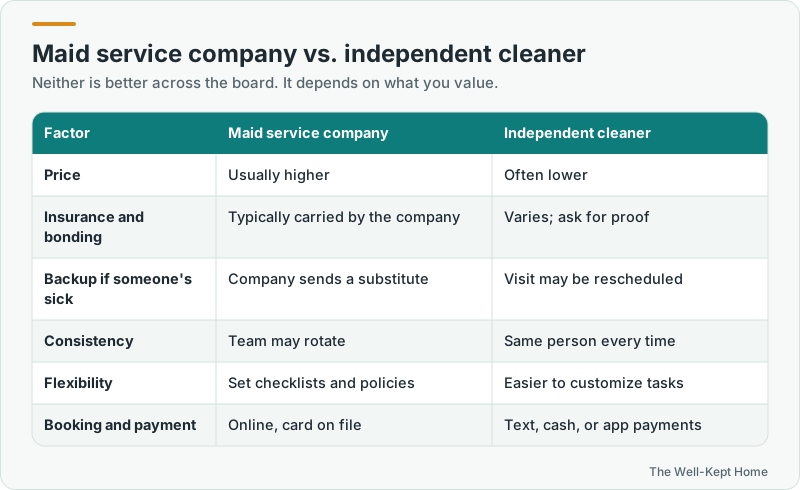
Cost
Independent cleaners often charge less because they have lower overhead: no office, no franchise fees, and less advertising. Companies charge more but include administration, insurance, and backup coverage in their price.
Consistency
An independent cleaner gives you the same person every time, who learns exactly how you like things done. Companies try to send consistent teams, but staff turnover and scheduling can rotate people.
Accountability
With a company, complaints go to a manager, and many offer a re-clean guarantee. With an independent cleaner, you deal directly with the person, which can be simpler or harder depending on the relationship.
Flexibility
Independent cleaners are often more willing to customize tasks, such as laundry, changing sheets, or organizing a closet. Companies tend to stick to checklists and charge for add-ons.
Insurance and liability
If a worker is injured in your home or something is damaged, insurance matters. Companies typically carry liability coverage, and many carry workers’ compensation. If you hire an independent cleaner, ask for proof of liability insurance, and ask your homeowners insurance agent how a worker injury would be handled.
What happens on the first visit
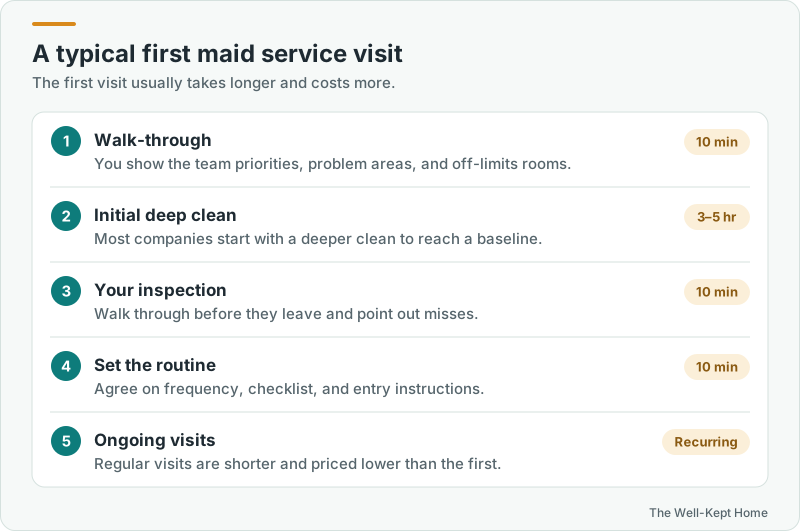
Most maid services start with a longer, deeper first clean to bring the home to a baseline they can maintain. Expect it to take longer and cost more than later visits. Walk through with the team at the start and end, and use that first visit to set expectations. See deep cleaning services for what to expect.
What maids usually don’t do
Policies vary, but many companies don’t:
- Move heavy furniture or appliances
- Clean up biohazards, such as bodily fluids or pest droppings, or handle mold remediation
- Climb tall ladders or wash exterior windows
- Do dishes, laundry, or organizing unless booked as an add-on
- Clean inside the oven or fridge unless booked as an add-on
Questions to ask a maid service
- Are your cleaners employees or contractors, and are they insured and bonded?
- Do you run background checks?
- Will the same team come each time?
- What’s on the standard checklist, and what do add-ons cost?
- What are your re-clean guarantee and cancellation policy?
- How do you handle keys, door codes, and alarm systems?
For an independent cleaner, ask the same questions, plus: do you carry liability insurance, how do you handle vacations and sick days, and how do you prefer to be paid?
How to choose
- Choose a company if you value reliability, backup coverage, insurance handled for you, and easy booking.
- Choose an independent cleaner if you value consistency, a personal relationship, flexibility, and potentially lower cost, and you’re comfortable checking insurance yourself.
Either way, ask the same vetting questions; see how to find and vet a house cleaning service.
Common questions
What’s the difference between a maid and a house cleaner?
In everyday use, the terms overlap. “Maid service” usually refers to a company with teams; “house cleaner” can mean either a company or an independent.
Is maid service more expensive?
Usually somewhat, per hour of cleaning. Teams can finish faster, though, so the per-visit price may be comparable.
Can I request the same team every time?
Yes. Ask for it when you book, and mention it again if the team changes often.
How much does maid service cost?
Prices vary by home size, frequency, and region. See house cleaning prices for typical ranges.